

> October 25, 2025, Shanghai Lingang Center. Under the spotlight, a performance curve charting more than four decades of rocket-like growth in computing power glowed behind Jack J. DONGARRA, now 74 years old. The 2021 Turing Award Laureate and Co-Chair of the Intelligent Science Conference at the 2025 World Laureates Forum opened his keynote with a striking insight, “What we truly need is software that can keep pace with the exponential growth of hardware.”
This single sentence distilled his life’s pursuit and perfectly defined his role at this moment in Lingang: a “software pathbreaker” who has infused supercomputing with its soul, engaging with Shanghai, this rising city of the East, on how open collaboration can harness the coming tidal wave of computational power.
Trajectory: From a Pizza Shop to Defining the Standards of Computing
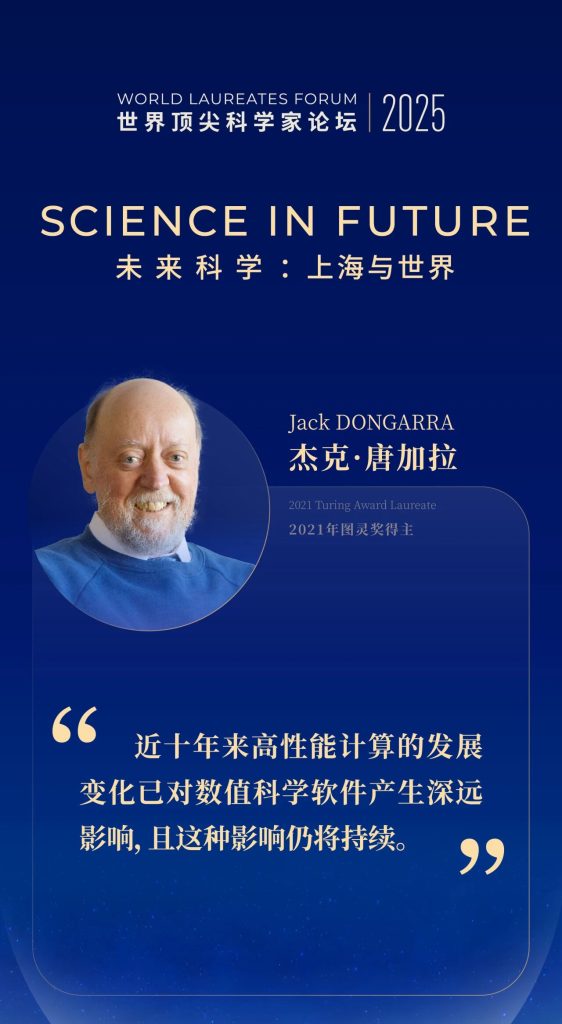
Beneath the title of “foundational architect of high-performance computing software”, Jack DONGARRA’s journey was anything but smooth. Born in 1950 into a Sicilian immigrant family in Chicago, he was the first in his family to attend university. In high school, he struggled with what would later be recognized as undiagnosed dyslexia and achieved only average grades. His original ambition was simply to become a high school mathematics teacher.
A turning point came in 1972. While studying mathematics at Chicago State University and working part-time at a pizza shop to pay tuition, DONGARRA secured an internship at nearby Argonne National Laboratory. There, he was tasked with testing a matrix computation software package known as EISPACK. The experience opened an entirely new world. He soon abandoned physics, committed himself to computer science, and embarked on a lifelong mission to unlock hardware potential through software.
His career reads like an epic of software-driven paradigm shifts. The LINPACK software library he led not only became a cornerstone of scientific computing, but also evolved into the LINPACK Benchmark, the global standard for measuring supercomputer performance. He went on to co-develop LAPACK, BLAS, and the distributed computing standard MPI, together forming the software backbone of modern scientific computing, enabling everything from weather forecasting to artificial intelligence.
One of his most visionary initiatives came in 1993, when he co-founded the TOP500 list of the world’s fastest supercomputers. Updated twice a year, this concise ranking has driven nearly three decades of global competition and progress in high-performance computing. The 2021 Turing Award citation captured the essence of his contributions,
“For pioneering contributions to numerical algorithms and libraries that enabled high-performance computing software to keep pace with exponential hardware advances for over four decades.”
Resonance: Developmental Threads and Future Blueprints from the Lingang Podium
In his opening keynote at the 2025 World Laureates Forum, Professor DONGARRA offered scientists and young scholars a clear narrative of the past, present, and future of high-performance computing. Beyond the traditional pillars of theory and experiment, he emphasized that computational simulation has emerged as the indispensable third paradigm, enabling humanity to study phenomena, such as galaxy collisions, that cannot be experimentally realized.
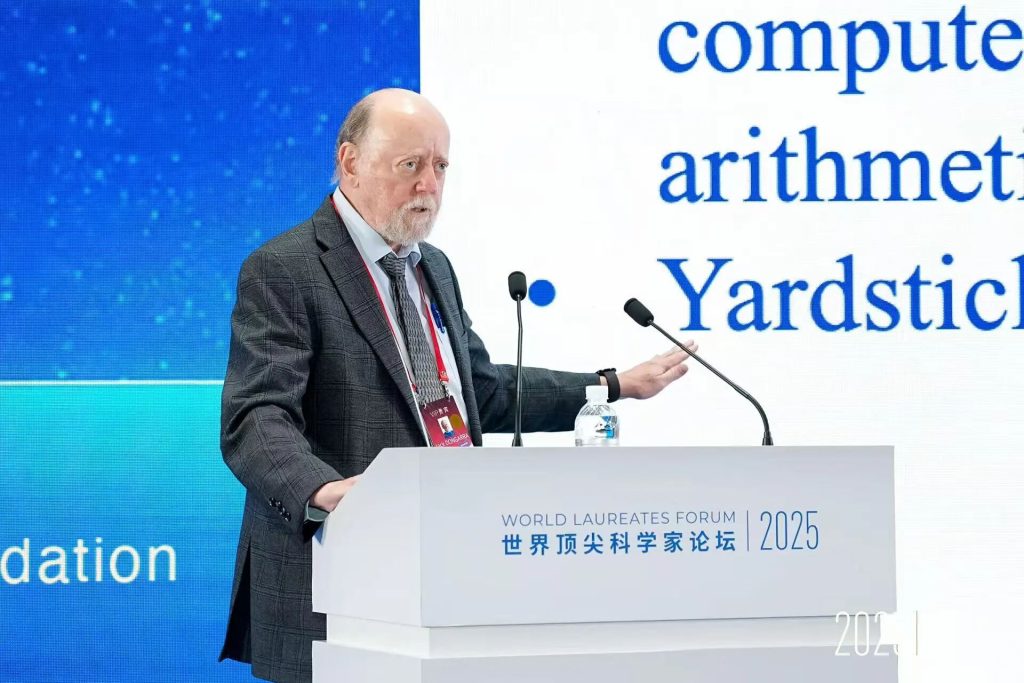
Jack DONGARRA delivering a keynote speech at the 2025 World Laureates Forum
With his characteristic humor, he revisited the forces behind the computing revolution, Moore’s Law and Dennard scaling, tracing the journey from refrigerator-sized 5MB hard drives to today’s thumbnail-sized terabyte storage devices. Yet he also highlighted the arrival of physical limits. As single-core frequency scaling hit the power wall, performance growth pivoted toward parallelism: from multi-core CPUs, to heterogeneous CPU–GPU architectures, and ultimately to interconnected systems of tens of thousands of nodes, culminating in exascale supercomputers capable of 10¹⁸ floating-point operations per second and occupying entire buildings.
As the architect behind the LINPACK Benchmark and the TOP500, he demonstrated how this 33-year “global competition” has precisely mapped computational leaps. In 1993, the world’s fastest supercomputer delivered less performance than an ordinary laptop today. At the top of the current ranking stands the U.S. system El Capitan, whose exascale capability means that computations completed in one second would take a typical computer four continuous years to finish.
Equally thought-provoking were his observations on the global landscape. He noted that China now operates a large number of high-performance computing systems and has independently developed multiple exascale supercomputers. While these achievements do not appear on international rankings due to complex geopolitical factors, their power is well recognized through academic publications. This, he emphasized, reflects China’s determination and capability to build a self-reliant advanced computing ecosystem.
Consensus: Science as a Universal Language, Software as the Key to the Future
In Lingang, Professor DONGARRA went beyond technical roadmaps to articulate his scientific philosophy. As Co-Chair of the Intelligent Science Conference, he stressed, “Science is a universal language, and cooperation is always the driving force behind scientific progress.” This belief set the tone for the Forum’s overarching theme, “Science in Future: Shanghai and the World.” In confronting global challenges such as climate change and disease control, he argued, only cross-border knowledge sharing can yield solutions.
His argument ultimately returned to the foundation of his life’s work: software. Faced with modern supercomputers composed of millions of cores and heterogeneous architectures, he stated candidly, “algorithms and software are actually the harder part.” Hardware provides theoretical peak performance, but only exceptional software and algorithms can transform that potential into real scientific discovery. This insight, consistent with his identity as a “software pathbreaker,” precisely defines the next core challenge of the computing era.
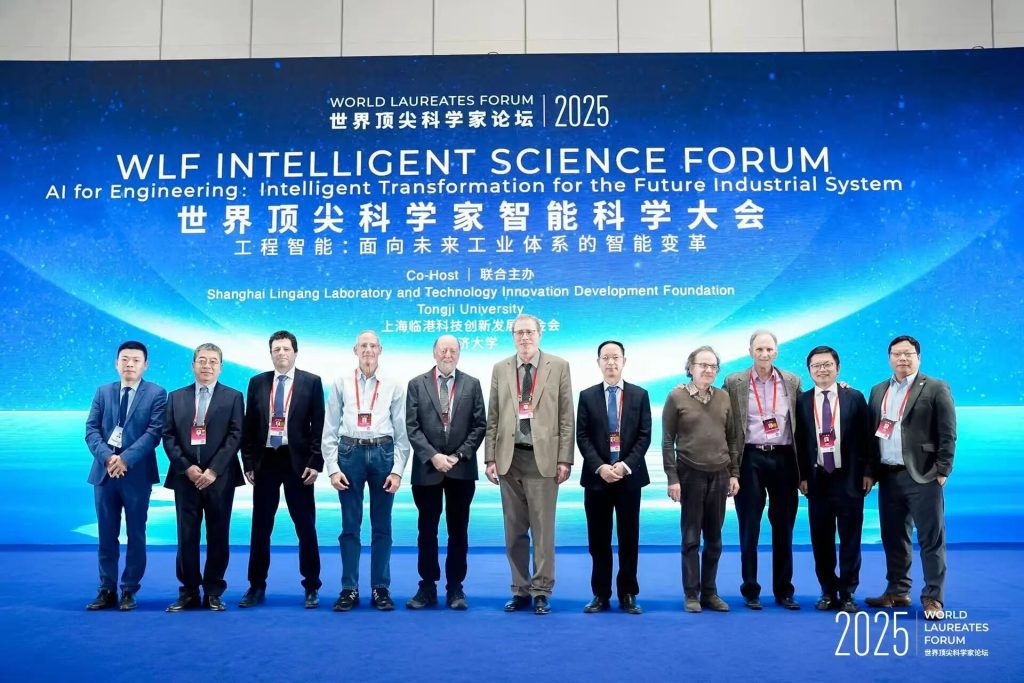
Jack DONGARRA at the Intelligent Science Conference of the 2025 World Laureates Forum
Linkages: From Global Benchmarks to the Lingang Innovation Ecosystem
Professor DONGARRA’s influence extends beyond ideas to the cultivation of future generations. In June 2025, the International Supercomputing Conference awarded the Jack Dongarra Early Career Award to Associate Professor GAN Lin of the National Supercomputing Center in Wuxi. It is the first time this award has been conferred on a Chinese scholar. This recognition signaled authoritative international acknowledgment of China’s strength in high-performance computing. GAN Lin’s work, applied to domestically developed systems such as Sunway TaihuLight, exemplifies how software algorithms and advanced hardware combine to address major needs in climate modeling and biomedicine.
This philosophy of using software to empower hardware in solving real-world problems closely aligns with the mission of the Shanghai Lingang Science and Technology Innovation Development Foundation. The Intelligent Science Conference, which brought together multiple Turing Award and Fields Medal laureates, stands as a prime example of how the Foundation fosters convergence between academic insight and industrial demand in Lingang. By hosting World Laureates Association Prizes and top-tier forums, the Foundation not only introduces cutting-edge global scientific thought, but also anchors it within local innovation ecosystems, actively building a continuum from basic research, to applied research, to technology transfer.
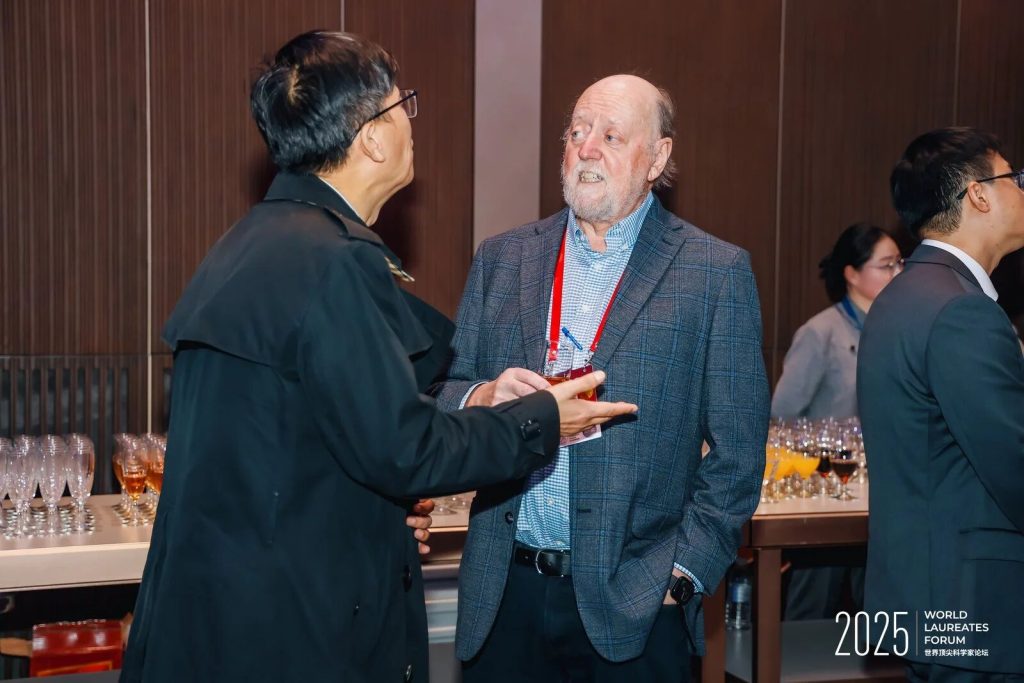 Jack DONGARRA participating in WLF Möbius Night at the 2025 World Laureates Forum
From the software libraries Jack DONGARRA pioneered, now the bedrock of global computing, to his assertion at the 2025 World Laureates Forum that “software is the harder part,” a single intellectual thread runs through his career: transformative progress arises from open collaboration, shared knowledge, and exceptional software that allows the world’s most powerful hardware to truly serve humanity.
Lingang, with its open posture, is becoming both witness and catalyst to this great endeavor. The Shanghai Lingang Science and Technology Innovation Development Foundation will continue to serve as a platform builder and connector of resources, striving to make Lingang a global salon for scientific thought and a testbed for frontier innovation. We believe that when the soul of software meets the strength of a rising city, and individual vision resonates with collective mission, a powerful force will emerge, capable of meeting the challenges of our time and shaping a shared future.
