


> “Curiosity is the foundation of all major scientific discoveries.”
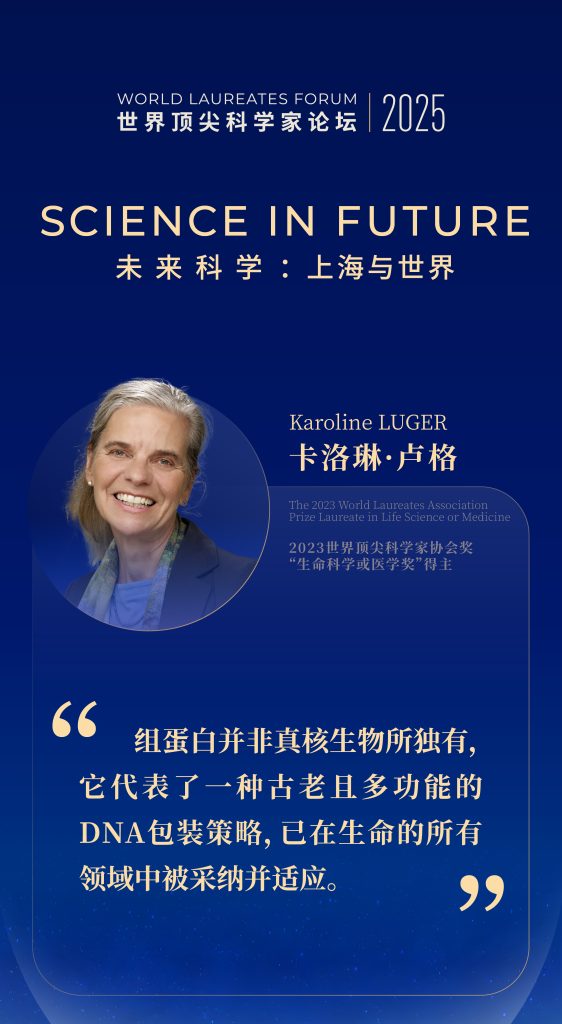
At the 2025 World Laureates Forum, a lecture tracing the origins of life from microscopic structure captivated the entire audience. Folding as much as 10 kilometers of DNA within a cell nucleus into a space the size of a golf ball. This vivid metaphor opened the scientific narrative presented by Karoline LUGER, Member of the U.S. National Academy of Sciences and recipient of the 2023 World Laureates Association Prize in Life Science or Medicine.
Her research, long enshrined in textbooks for revealing the nucleosome structure and laying the foundation of modern chromatin biology, now leads listeners on a far more expansive intellectual journey.
Chapter 1
A Journey of Information Compression Across Three Billion Years
At the opening ceremony, Professor Karoline LUGER drew the audience in with a scientific narrative spanning three billion years.

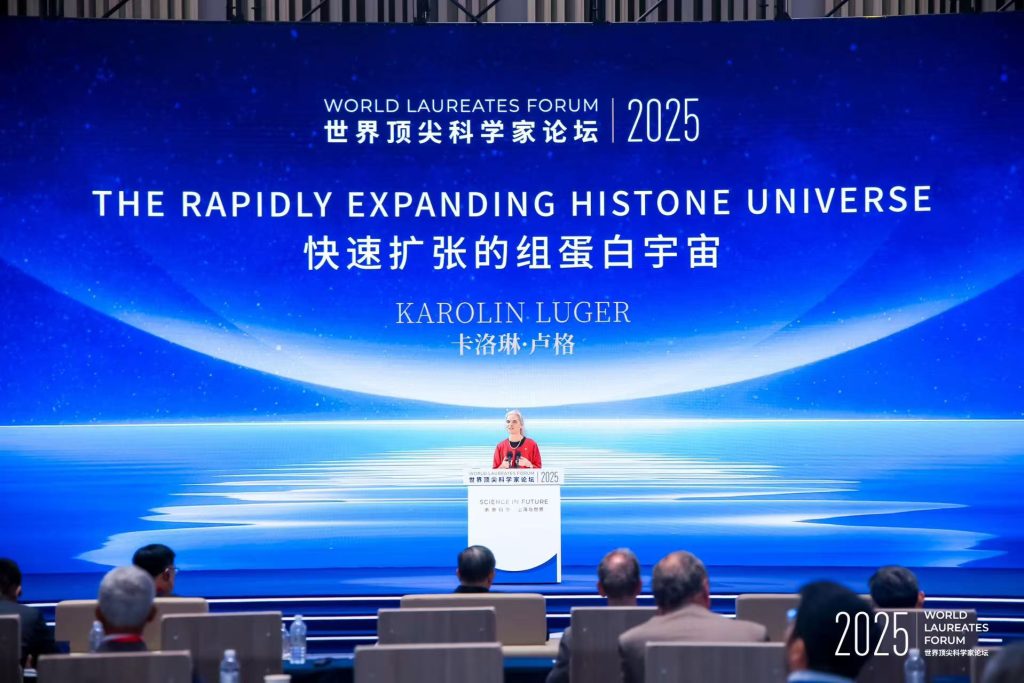
Karoline LUGER delivers a lecture at the 2025 World Laureates Forum
“Packing 10 kilometers of DNA inside the human cell nucleus into a space the size of a golf ball, without tangling or knotting, represents the daily information-management challenge faced by eukaryotic cells,” she explained. This constraint resembles the physical limits once encountered by magnetic tape, yet life evolved an exquisite solution: chromatin.
She systematically outlined her team’s research trajectory since resolving the nucleosome structure in 1997 and turned to a deeper evolutionary question: where did DNA-compressing histones originate? To answer this, her laboratory explored the margins of the living world: archaea, giant viruses, and even bacteria.
01
Giant Viruses: Independent “Inventors” of Histones?
Professor LUGER presented her team’s breakthrough discoveries in giant viruses such as Mimivirus. Remarkably, these viruses encode their own histones and form structures even more stable than eukaryotic nucleosomes. “This is not theft from hosts but may represent an independent evolutionary event.” Electron-microscopy comparisons showed that viral histones efficiently compress and protect genomes, ensuring rapid replication and infection. This finding challenges the traditional belief that histones are exclusive to eukaryotes.
02
Archaeal Chromatin: Flexible Strategies in Extreme Environments
Her team also identified primitive histone forms in archaea. Unlike the stable and conserved nucleosomes of eukaryotes, archaeal histones can flexibly alter DNA packaging in response to environmental extremes such as high temperature or acidity. “Histones may have first functioned as purely protective ‘armor,’ enabling survival under harsh conditions. Eukaryotes later evolved complex epigenetic regulatory roles upon this foundation.”
03
Overturning Textbooks: Histone-Like Proteins in Bacteria
Perhaps the most surprising discovery emerged from bacteria. Screening approximately 18,000 bacterial genomes, Professor LUGER’s team identified genes encoding histone-like proteins. She highlighted a predatory bacterium named Vampirococcus luggeri, named after her surname, which efficiently expresses a histone-like protein sharing only 20% homology with human histones yet fully wraps DNA into a unique protective structure. “This suggests that the need for DNA compression may be universal across the tree of life, and histone-based solutions may have evolved independently multiple times.”
Chapter 2
Curiosity-Driven Basic Research as the Source of Transformative Innovation
Professor LUGER emphasized that these seemingly niche investigations into histones in viruses, archaea, and bacteria are driven purely by curiosity.
“We study why viruses use histones not only to trace evolutionary history. The mechanisms may also inspire new antiviral drugs or gene-regulation tools.” She expressed particular appreciation for the Forum’s recognition of the value of basic science, adding,
“Research must allow failure, because unpredictability is precisely where discovery becomes possible.”
In an era focused on applications and outputs, her defense of the purity of fundamental science is especially powerful.
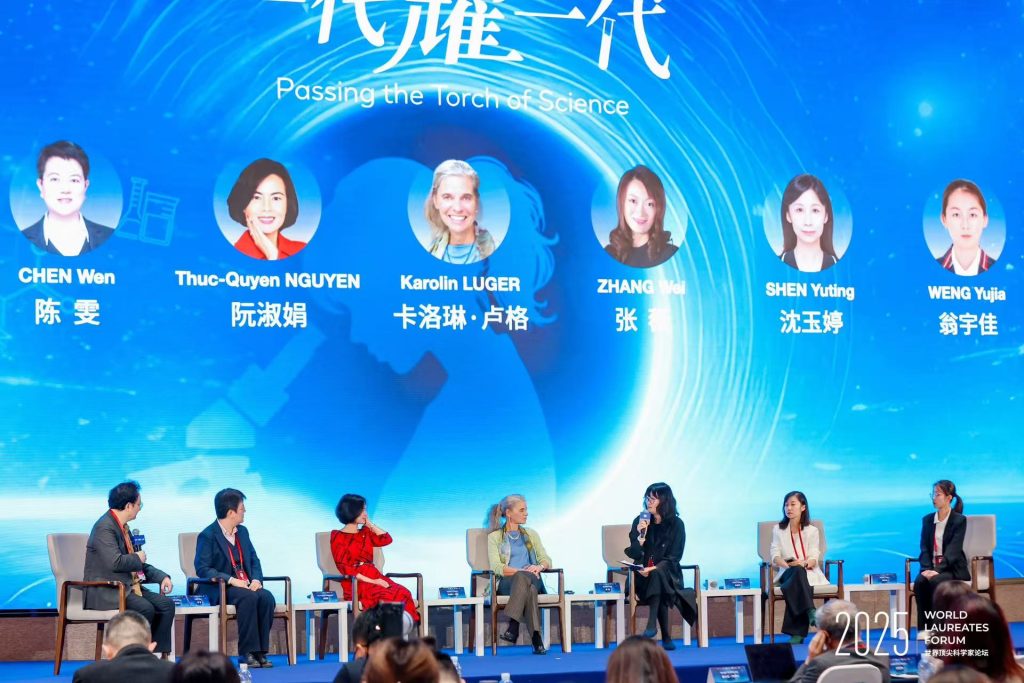
Karoline LUGER participates in the ‘Passing the Torch’ session at the 2025 World Laureates Forum
Chapter 3
Legacy and Perseverance of a Structural Biology Pioneer
Professor LUGER’s scientific career itself exemplifies the spirit of her lecture. As a young scholar at the University of Innsbruck in Austria, she experienced the “shock and joy” of purifying a protein for the first time. During her doctoral and postdoctoral work at the University of Basel and ETH Zurich, she chose the formidable challenge of nucleosome structural determination, achieving a landmark breakthrough in 1997. After joining the University of Colorado, she established a world-leading structural biology laboratory and trained numerous active scientists.
Her research spans structure, evolution, and disease, elucidating mechanisms involving the nucleosome assembly factor FACT and chromatin remodeler SMARCAD1, and, with collaborators, uncovering the “monkey-bar” mechanism of PARP in DNA repair, offering key insights for targeted cancer therapeutics.
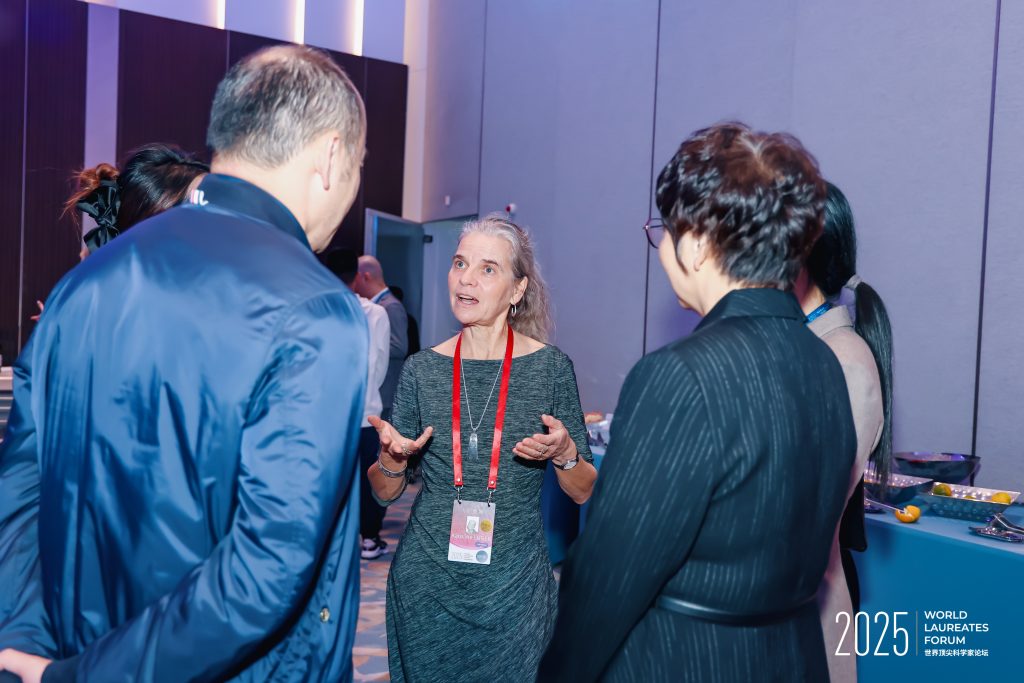
Karoline LUGER participates in the WLF Möbius Night at the 2025 World Laureates Forum
Chapter 4
Building Platforms for Science to Illuminate the Future
As an organizer of the 2025 World Laureates Forum, the Shanghai Lingang Science and Technology Innovation Development Foundation is honored to welcome Professor Karoline LUGER. Her lecture not only demonstrates the fundamental power of basic science to expand the boundaries of knowledge but also embodies the enduring spirit of curiosity, resilience, and collaboration.
Her journey across the three domains of life resonates deeply with Lingang’s mission. What we strive to build is more than a physical venue for international dialogue. It is a beacon of ideas that illuminates curiosity-driven exploration and supports paradigm-challenging breakthroughs. Her story shows that major discoveries begin with persistent questioning of fundamental problems and flourish through courageous exploration of unconventional paths.
By gathering global wisdom, Lingang seeks to cultivate an innovation ecosystem that embraces unpredictability and encourages imagination, allowing scientists like Professor Karoline LUGER to freely share discoveries that may lack immediate utility yet reshape the foundations of human understanding.
The Shanghai Lingang Science and Technology Innovation Development Foundation will continue to advance this mission: supporting frontier exploration, fostering deep dialogue, and nurturing interdisciplinary integration. Together with the global scientific community, we aim to make Lingang fertile ground for future breakthroughs and a place where humanity’s long-term challenges can be confronted collectively.
In Lingang, ideas transcend borders and disciplines. The path of exploration from nucleosomes to the origins of life presented by Professor Karoline LUGER will continue to inspire generations of scientists to uncover nature’s deepest secrets, guided always by curiosity.

