


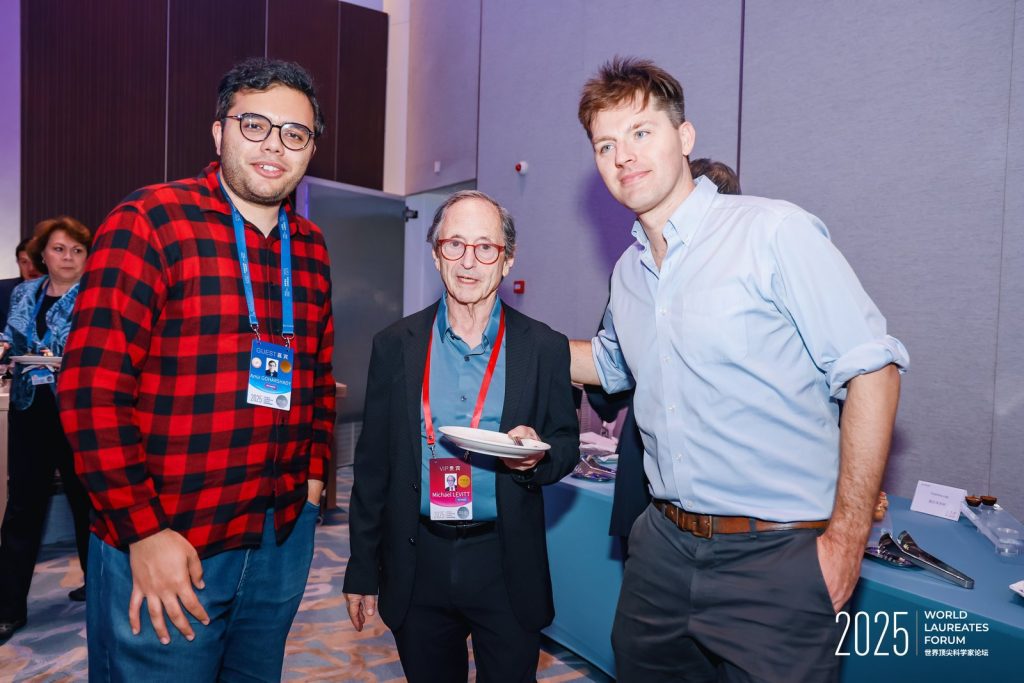
> At the World Laureates Forum, if you happen to notice an elderly gentleman with silver hair and red-framed glasses moving briskly between venues, sometimes sketching ideas with young scientists on a tablecloth, sometimes effortlessly scanning QR codes in the corridor, you have likely met Michael LEVITT. Forum staff affectionately call him “a little bird that flies everywhere.” The nickname captures not only his physical presence, but also the very essence of his scientific life, one that transcends disciplines, borders, and generations. A frequent visitor to Lingang, Michael LEVITT’s life journey itself stands as a vivid testament to how curiosity, chance, and cross-boundary exploration shape great scientific discoveries.
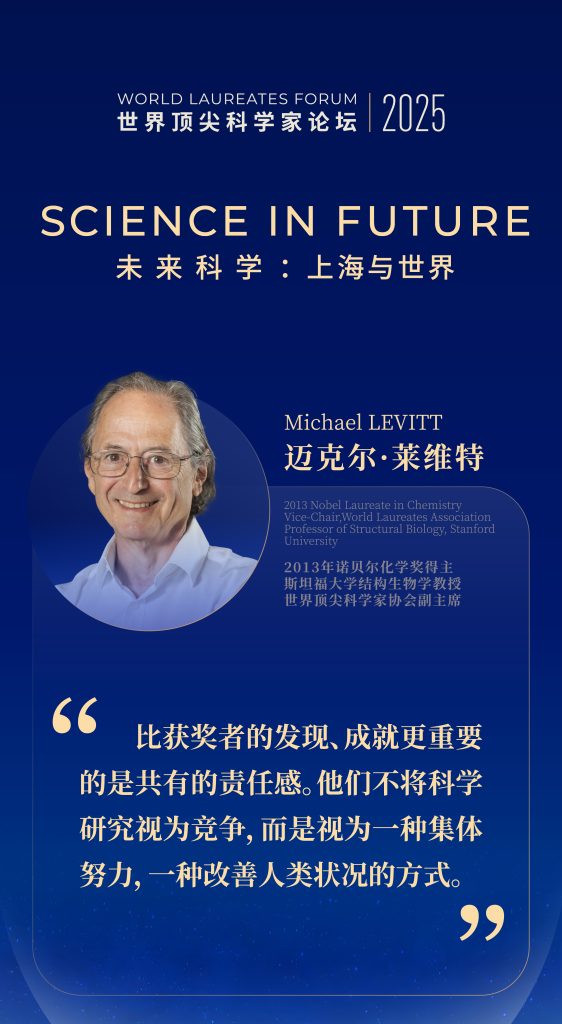
From a “Restless Teenager” to a “Cross-Disciplinary Marathoner” Serendipity, Courage, and Half a Century of Persistence
Michael LEVITT’s scientific legend began with a family “deal” and a chance television encounter. At the age of 15, after returning home late one evening driven by youthful restlessness, his mother redirected his excess energy toward academics, helping him skip high school entirely and enter university directly. At 17, a popular science television program, The Thread of Life, hosted by Nobel Laureate John KENDREW, unexpectedly ignited his lifelong passion for deciphering protein structures through mathematics and physics. That spark led to an even bolder move. After his written application was rejected, the shy young LEVITT drove to Cambridge in person, wandering the corridors until he encountered Max PERUTZ, introducing himself unannounced and securing a place at the heart of scientific inquiry. This moment not only opened the gates to his scientific career, but also brought him into contact with future Nobel collaborators.
This act of “knocking on the door” foreshadowed a lifetime defined by interdisciplinary exploration and marathon-like endurance. From physics and mathematics to biology and computer science, LEVITT traversed disciplinary boundaries without hesitation. In the 1970s, when experimental biology still dominated the field, he boldly adopted computers as his primary research tool, venturing into what was then an uncharted territory: computational biology. This lonely path even led him to become an early practitioner of what we now call “remote work.” From the first spark of insight to receiving the 2013 Nobel Prize in Chemistry, this journey spanned nearly half a century. Such endurance, maintaining curiosity, embracing uncertainty, and daring to move against the current, became the cornerstone of his singular scientific path.
A “Slash” Soul on the WLF Stage Crossing Boundaries, Empowering Youth, and Embracing AI
On the stage of the World Laureates Forum, where interdisciplinary convergence is celebrated, Michael LEVITT feels entirely at home. His own academic path is the embodiment of a “slash life.” He repeatedly emphasizes that “there should be no boundaries between disciplines,” noting that “when people from different fields talk to each other, interesting things happen.” This philosophy lies at the heart of WLF’s vision and resonates deeply with Lingang’s innovation ecosystem.
His passion for young scientists is equally striking. He encourages them to “ask questions like a seven-year-old” and to embrace mistakes without fear. At the same time, he approaches emerging technologies with childlike enthusiasm.
A keen observer of China’s digital life, LEVITT is also an active user and advocate of artificial intelligence. He chats with AI daily, seeking advice ranging from emotional wellbeing to art appreciation. He often points out, with delight, that the immense computing power fueling today’s AI revolution partially stems from young people’s demand for high-definition video games. Great discoveries, he reminds us, often originate in unexpected places. This ability to connect cutting-edge research with everyday human curiosity is a living expression of his cross-disciplinary mindset.
Flying to Lingang Building a Scientific Haven for “Curious Little Birds”
Like a “migratory bird of science,” Michael LEVITT ultimately found a home in Shanghai and in Lingang. What attracted LEVITT was far more than a single research position. He marveled at the “China speed” embodied by the Institute for Multiscale Research of Complex Systems, seeing it as a symbol of the city’s determination to build a world-class research ecosystem. He praises China’s openness toward technological adoption, just as QR codes have achieved near-universal use, believing that true innovation lies in empowering humanity.

In Lingang, he sees fertile ground where his scientific ideals can take root. The region’s focus on artificial intelligence, biomedicine, and integrated circuits aligns seamlessly with his advocacy for computational biology, multiscale modeling, and interdisciplinary integration. The planned International Innovation Collaboration Zone reflects his long-held belief that science should not be constrained by geography. Lingang represents a form of innovation courage, daring to invest in the future, to commit to long-term fundamental research, and to build an open system that attracts global wisdom. This spirit mirrors LEVITT’s own 45-year perseverance in tackling a single scientific challenge, and his bravery in crossing disciplinary frontiers. Their shared values meet at the deepest level.
As a co-organizer of the World Laureates Forum, the Shanghai Lingang Science and Technology Innovation Development Foundation finds Michael LEVITT’s story profoundly inspiring. His achievements are not the product of genius alone, but of curiosity sustained from youth to old age, of the courage to knock on opportunity’s door, of the endurance to run long distances through interdisciplinary “no-man’s land”, and of a sincere commitment to passing wisdom on to the next generation.
Lingang New Area is a place that encourages curiosity, tolerates failure, supports cross-boundary exploration, and balances speed with patience. When Michael LEVITT’s figure moving between forum venues overlaps with Lingang’s skyline of rising cranes, we witness a mutual choice, between a great scientist and an emerging innovation hub, grounded in a shared understanding of what innovation truly means. Here, curiosity that flies on serendipity will ultimately find the firm anchor needed to move the world forward.

