


At the venue of the 2025 World Laureates Forum in Shanghai Lingang, we met a scientist attending the Forum for the first time, Clifford Paul BRANGWYNNE. Wearing glasses, he spoke with gestures that seemed to trace the microscopic world inside the cell. His tone carried the quiet certainty of an engineer.
BRANGWYNNE and Anthony HYMAN received the 2023 Breakthrough Prize in Life Sciences, sharing a three-million-dollar award, one of the most substantial prizes in global science. They were recognized for “discovering a fundamental mechanism of cellular organization mediated by phase separation of proteins and RNA into membraneless droplets”. The discovery has been described as a fundamental advance in understanding cellular organization, with future potential for clinical applications, including the treatment of neurodegenerative diseases such as ALS.
Less widely known is that the scientist who helped reshape cell biology studied materials science and engineering as an undergraduate, and also minored in physics. Across his career, he has pursued one central task: turning the lenses of physics and engineering toward biology.

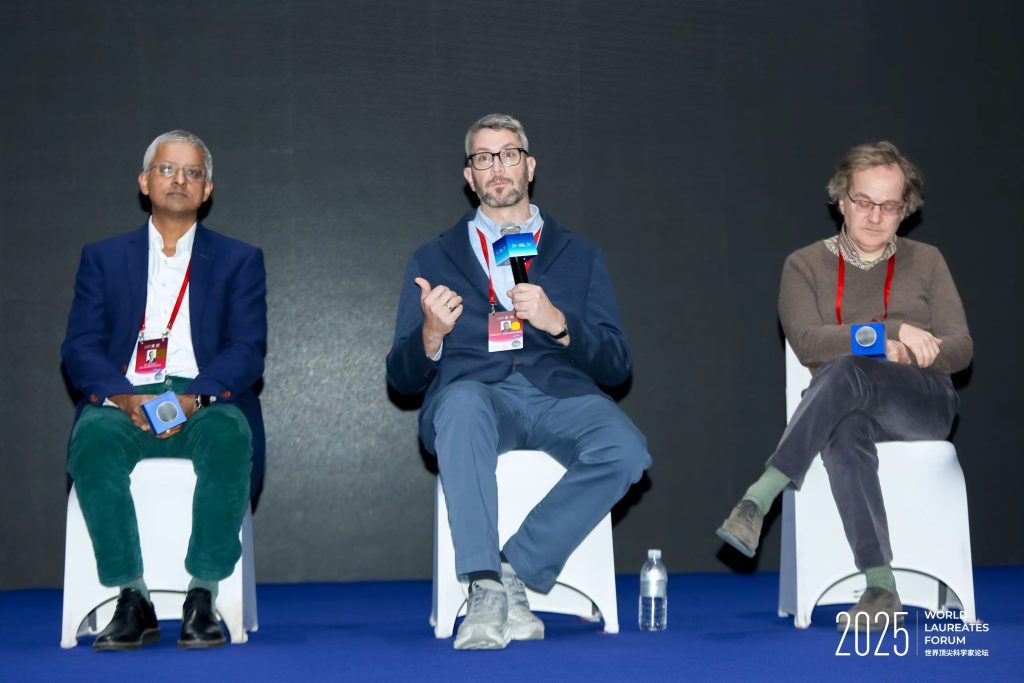
Cells Are Not “Soup,” They Are “Jungle”
Before BRANGWYNNE’s work emerged, the prevailing view in the field was that internal cellular structures were divided by biological membranes, like separate soap bubbles. In 2009, the paper he published with HYMAN in Science changed this understanding. Many functional structures inside cells, they showed, are more like suspended droplets. Biomolecules can spontaneously condense through phase separation, forming liquid condensates without surrounding membranes.
Phase separation is a familiar phenomenon in everyday life. Oil and water do not mix; water vapour condenses into droplets when cooled. Both are examples of this physical process. Yet no one had previously connected it to the mechanisms of cellular organization. BRANGWYNNE’s breakthrough was to demonstrate that biological macromolecules such as proteins and RNA can condense inside cells into distinct droplets, naturally separated from the surrounding aqueous environment.
Philip LE DUC, Professor of Mechanical Engineering at Carnegie Mellon University, offered an image to explain the change in perspective. Many people may imagine a cell as a bowl of soup with a few noodles floating inside, “but it is actually more like a jungle”. Although the cell interior is extremely crowded, cells remain able to operate efficiently through mechanisms such as phase separation. LE DUC has noted that BRANGWYNNE opened a highly influential new direction of research, reshaping the field’s conceptual framework with exceptional creativity.
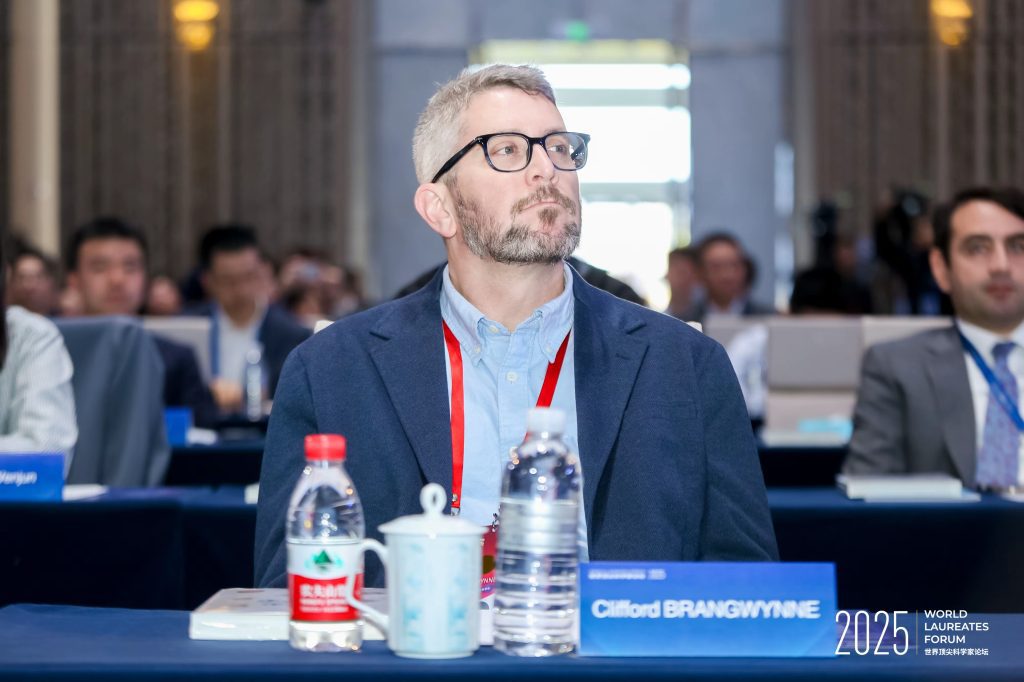

Youth Scientists Conference at the 2025 World Laureates Forum
An Unconventional Path
BRANGWYNNE’s own path is itself a story about the courage to cross boundaries.
He grew up in a working-class family in the Boston area, among relatives who included plumbers, painters, electricians, and nurses. He was the first generation in his family to attend university. After entering Carnegie Mellon University, he had a broad but uncertain interest in psychology, Spanish, and biology, and did not yet know that he would move toward engineering. In his first year, he took an introductory materials course simply because he had once had an interesting conversation in high school with an MIT graduate student in materials science. He was soon drawn into the field.
Even while majoring in materials science and engineering, he minored in physics. In his second year, he began working in a biology laboratory. Later, he took a year away from his studies to continue exploring cells in a laboratory at Harvard University. At first, the courses in materials science and engineering seemed unrelated to the biological research he was doing. Yet in many ways, his career has been devoted to bridging these two fields, and, as he has said, “it all began at Carnegie Mellon University”.
In 2007, BRANGWYNNE received his PhD in applied physics from Harvard University. He then joined HYMAN’s laboratory at the Max Planck Institute of Molecular Cell Biology and Genetics as a postdoctoral researcher. It was there that he and HYMAN made the discovery that would change cell biology.
In 2011, he joined the Department of Chemical and Biological Engineering at Princeton University. At that time, the 2009 paper had been cited fewer than ten times. Yet he and his colleagues continued to produce new work, gradually extending the original discovery. Slowly, a scientific community began to notice this new field and join it. Today, researchers have shown that liquid-liquid phase separation regulates protein assembly, gene expression, immune responses, and cell proliferation, while its abnormal imbalance may contribute to cancer and a range of other diseases.

Youth Scientists Conference
From Basic Theory to Precision Clinical Therapy
The Breakthrough Prize announcement noted that BRANGWYNNE’s discovery may one day be applied clinically, including in the treatment of neurodegenerative diseases such as ALS.
In 2012, researchers began linking dysregulated phase separation to Alzheimer’s disease and ALS.
In 2017, related mechanisms were shown to be deeply involved in gene regulation.
In his keynote speech at the World Laureates Forum, BRANGWYNNE used vivid analogies to explain his research. The cell, he said, is not a rigid mechanical model as often presented in textbooks. It is a continuously dynamic, self-assembling liquid molecular system. Macromolecules such as proteins can gather within seconds into droplets ranging from nanometres to micrometres in size, perform physiological functions, and then rapidly disperse.
He presented several innovative tools developed by his team: generating droplets at designated genomic sites within ten seconds; quantifying chromatin elasticity in living cells for the first time by measuring the “capillary forces” produced as droplets contract; and using deep learning to analyse changes in nucleolar morphology, allowing drug EC50 values to be predicted from microscope images alone. More importantly, based on these platforms, his team has identified small molecules capable of reversing excessive nucleolar activation. These molecules have shown tumour-suppressing effects in animal models, and related drug candidates have entered preclinical evaluation. He emphasized that over the next five to ten years, “phase-separation drugs” may become a new direction in precision therapy.
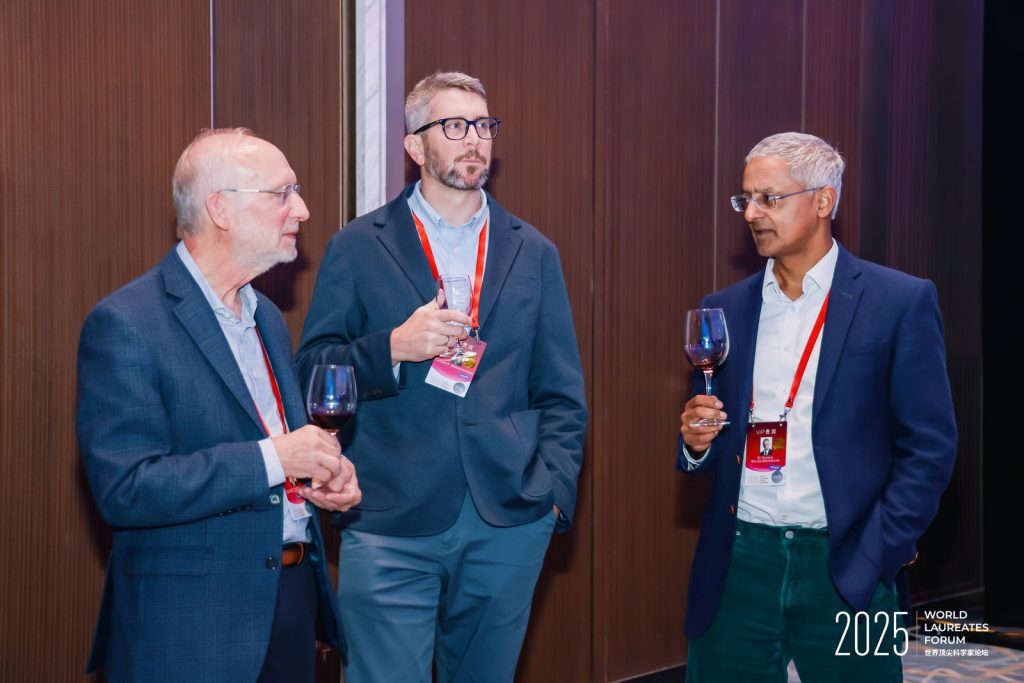
WLF Möbius Night at the 2025 World Laureates Forum
A Voice in Lingang
At the 2025 World Laureates Forum, BRANGWYNNE took part in several dialogues and exchanges. He encouraged young scholars in the audience to “look at biological problems through physical thinking, and use engineering methods to test scientific hypotheses.” This is a faithful expression of his own research philosophy: to cross boundaries with courage, and to turn the lenses of different disciplines toward the same question.
His scientific journey, from materials science to biology, from physics to engineering, and from basic research to drug development, has challenged convention at almost every step. He has said that he was “very fortunate to work with outstanding collaborators in opening this new field”. Yet he also knows that it all began with a choice that did not appear entirely reasonable at the time.
When asked what message he would offer to the younger generation, he said, “I think you have to be a little bold, a little brave, and follow your heart and your interests, even if they may not seem completely reasonable to others.”
This may be the most valuable gift BRANGWYNNE brought to the 2025 World Laureates Forum: the courage to cross disciplinary boundaries, and to rewrite cell biology in the language of physics. Through his own experience, he has shown that true innovation often emerges at the intersections of disciplines. When basic research meets clinical need, and when physical thinking embraces the life sciences, breakthroughs that once seemed distant may eventually reach the patient’s bedside.
As he often tells young scholars: “Be brave, and follow your heart.”

