


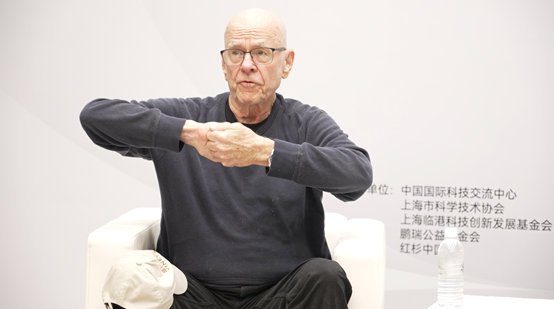
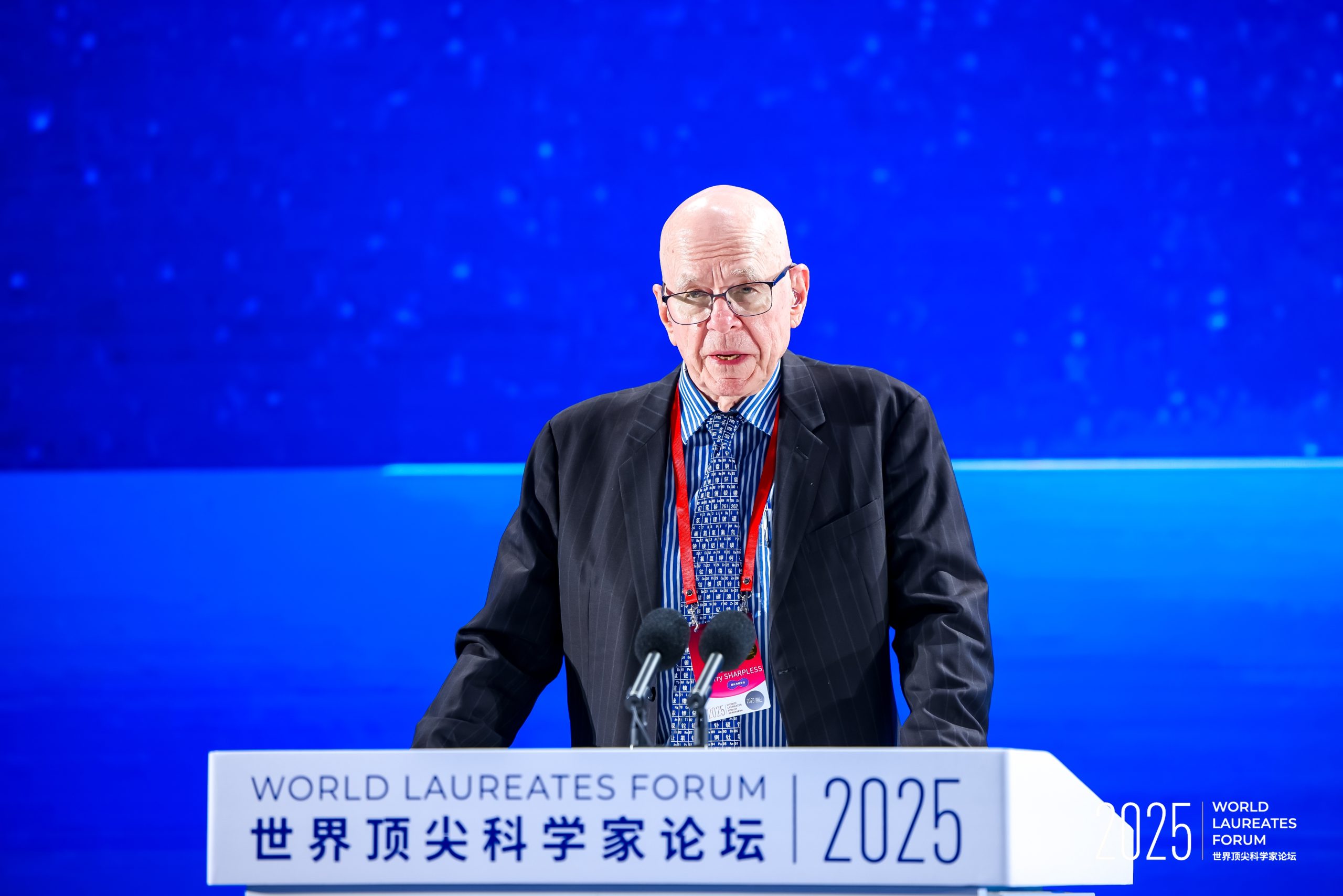
>Among the many remarkable moments at the 2025 World Laureates Forum, one figure remained unforgettable: Professor K. Barry SHARPLESS, the 84-year-old, sharp-minded double Nobel Laureate, wearing his signature canvas hat as if he had just stepped out of the laboratory he so dearly loves. As the fifth person in history to win two Nobel Prizes, his presence in Lingang was not only a powerful endorsement of the Forum’s global influence, but also a vivid reminder of how a philosophy rooted in “simplicity” is reshaping the future of science.
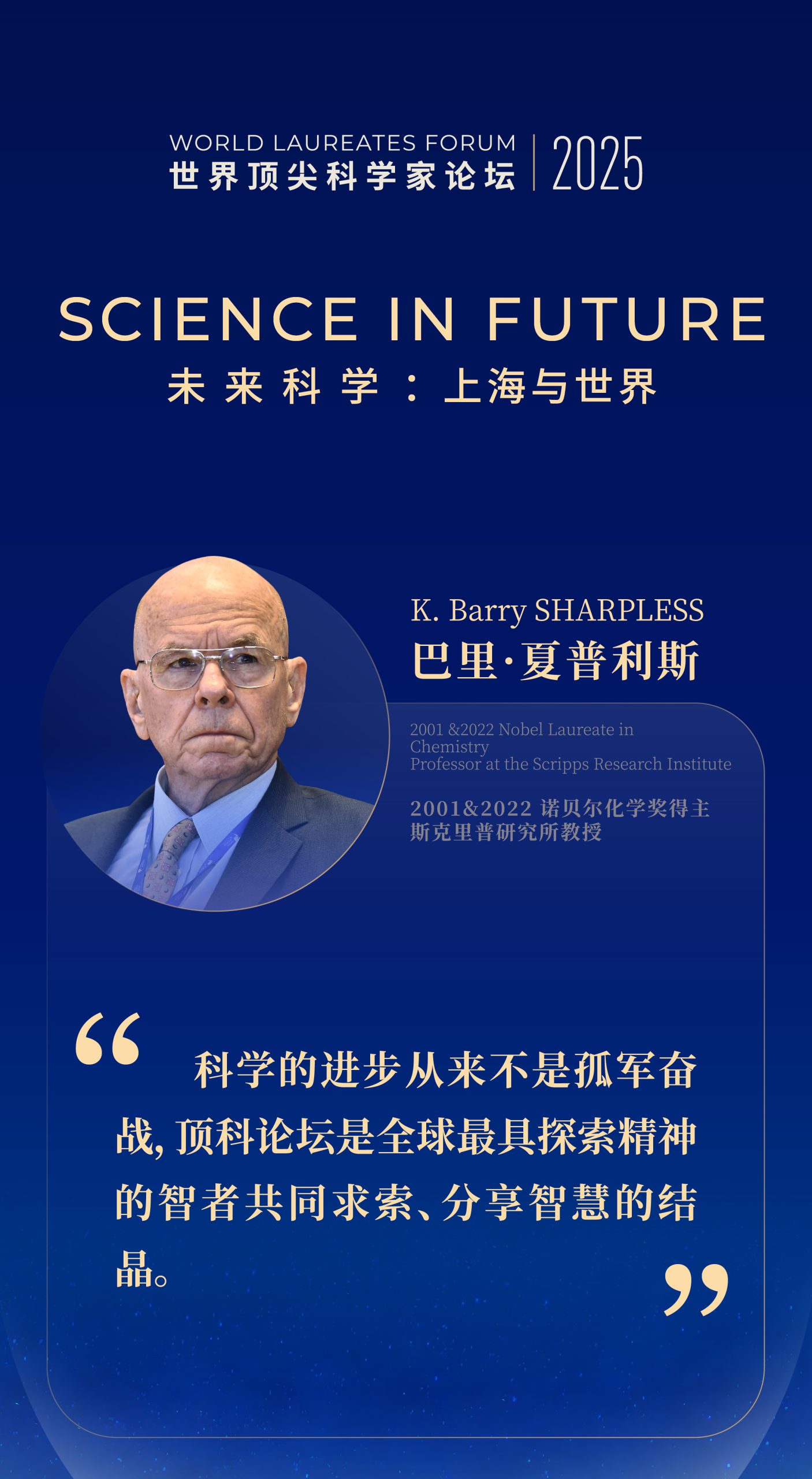
A Dual Crown: A Scientific Journey from Asymmetric Catalysis to Click Chemistry
Professor SHARPLESS’s scientific legend began with his mastery of chirality, the precise control of molecular handedness.
In 2001, he was awarded the Nobel Prize in Chemistry, together with William S. KNOWLES and Ryoji NOYORI, for pioneering asymmetric catalytic oxidation reactions. This work solved a foundational challenge in drug synthesis: how to perform “molecular surgery” with precision, producing only the desired enantiomer while avoiding ineffective or harmful ones. It laid the groundwork for safer and more effective pharmaceuticals.
In 2022, he received his second Nobel Prize in Chemistry for establishing the field of click chemistry and bioorthogonal chemistry. From solving the problem of molecular chirality to inventing a molecular “fastener” that connects chemical units with exceptional reliability, SHARPLESS demonstrated the profound power of simplicity and robustness.
His achievements also forged a strong scientific bond between China and the global research community. As early as 2004, he was appointed Honorary Professor at the Shanghai Institute of Organic Chemistry, Chinese Academy of Sciences, followed by honorary titles from Nanjing University, Tianjin University, and other leading Chinese institutions, marking a long-lasting relationship with China’s scientific community.
A Conceptual Revolution: How Click Chemistry Is Transforming Scientific Paradigms
At the heart of click chemistry lies the wisdom of reducing complexity. In the 1990s, Professor SHARPLESS envisioned a new ideal: to discover reactions that function like “buckling a seatbelt”, fast, precise, reliable, and nearly free of side reactions. The goal was to assemble small, stable molecular modules into a vast diversity of functional structures.
This philosophy gave rise to the iconic “molecular connection” paradigm. In 2002, the SHARPLESS laboratory unveiled the copper-catalyzed azide–alkyne cycloaddition (CuAAC), the first near-perfect realization of his vision, a universal molecular “click” mechanism. To enable applications inside living systems, the field soon expanded to strain-promoted azide–alkyne cycloaddition (SPAAC) and later to the groundbreaking SuFEx (sulfur(VI) fluoride exchange) chemistry, ushering click chemistry into its “2.0 era.”
Today, this “simple” revolution permeates nearly every scientific frontier:
In drug discovery, it allows scientists to build immense compound libraries like molecular LEGO, dramatically accelerating the search for new therapeutic candidates.
In life sciences, bioorthogonal chemistry enables precise labeling and regulation of biomolecules inside living cells without disturbing natural biological processes—opening new windows into the mysteries of life.
In materials science, it enables the tailored synthesis of functional polymers, smart hydrogels, and advanced materials with programmable properties.
At its core, click chemistry elevates chemical synthesis to a level of predictability and reliability comparable to engineering, providing researchers with a powerful standardized toolkit that frees them from synthetic complexity and redirects creativity toward function and innovation.
Legacy and Bridges: Lingang’s Mission and the Future of Science
As a Forum co-organizer, the Shanghai Lingang Science and Technology Innovation Development Foundation sees fostering generational scientific exchange and advancing international collaboration as central to its mission. Throughout the Forum, Professor SHARPLESS repeatedly praised the talent, curiosity, and determination of Chinese scientists and young scholars, qualities he viewed as key to China’s rapid rise in scientific research. His own career is a vivid example of cross-border and cross-generational scientific collaboration.
The Forum remains committed to its tradition of placing young scientists at center stage. In conversations with young researchers, SHARPLESS shared his humble yet profound scientific philosophy: stay curious, keep asking simple questions, and remember that the greatest breakthroughs often emerge from re-examining common sense.
He recalled early skepticism toward his asymmetric catalysis work. Yet it was precisely his conviction in seeking “simple” solutions that eventually transformed the entire field.
His message deeply resonated with the Foundation’s mission of empowering young scientific talent.
The 2025 Forum in Lingang brought together around 150 leading scientists from over ten countries, including multiple Nobel, Turing, and major-prize laureates, as well as academicians of the Chinese Academy of Sciences and the Chinese Academy of Engineering. Professor SHARPLESS’s active participation not only highlighted his unparalleled scientific achievements, but also symbolized a spirit of openness, collaboration, and relentless pursuit of fundamental breakthroughs.
The Forum may have concluded, but the pursuit of knowledge is endless. As Professor SHARPLESS remarked, “My brain never rests.” We will continue to uphold our mission to support this tireless spirit of exploration and to strengthen the scientific bridge connecting China and the world, the present and the future. We believe that on the innovative soil of Lingang, more revolutionary ideas, simple at first glance yet powerful enough to reshape the world, will surely take root, just as click chemistry once did.

