


Twice a silver medalist at the International Mathematical Olympiad in his youth, crowned with the Fields Medal at the age of 35, he later turned his attention from academic triumphs toward foundational education and artificial intelligence. Leaving the traditional academic world behind, he joined a Huawei research laboratory.
In Lingang, he offered a simple message, “Give young people sufficient time to explore new ideas and new methods.”
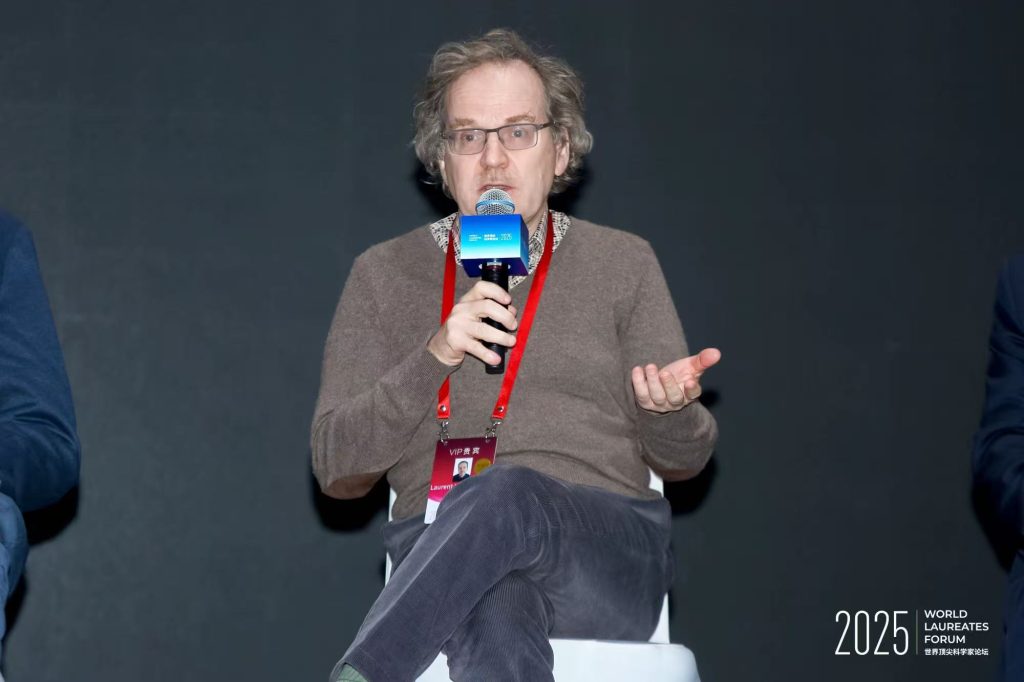
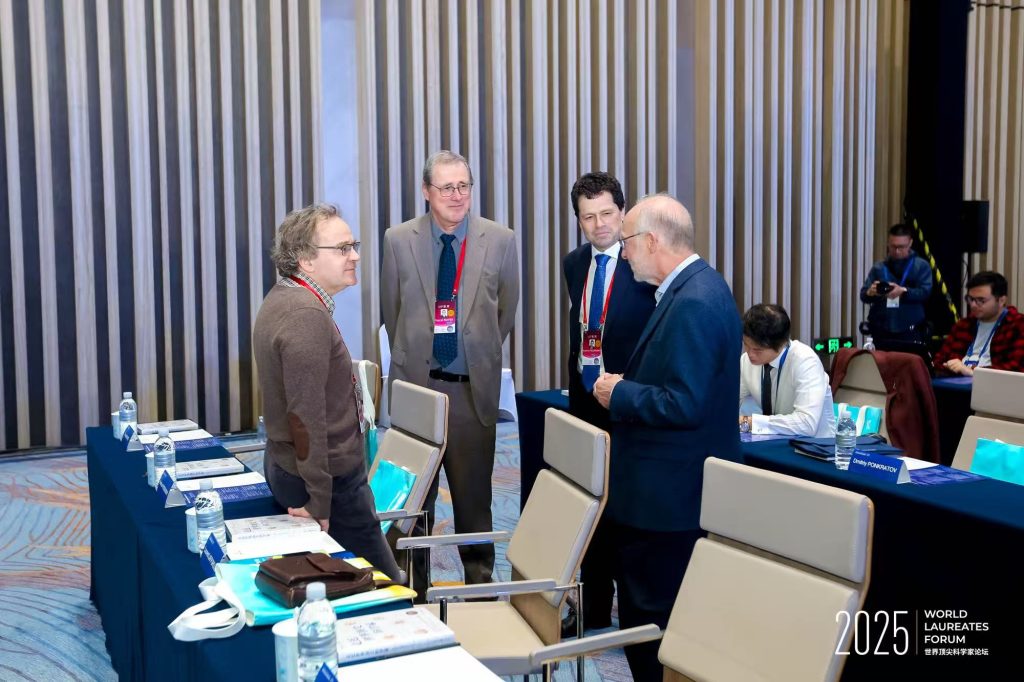
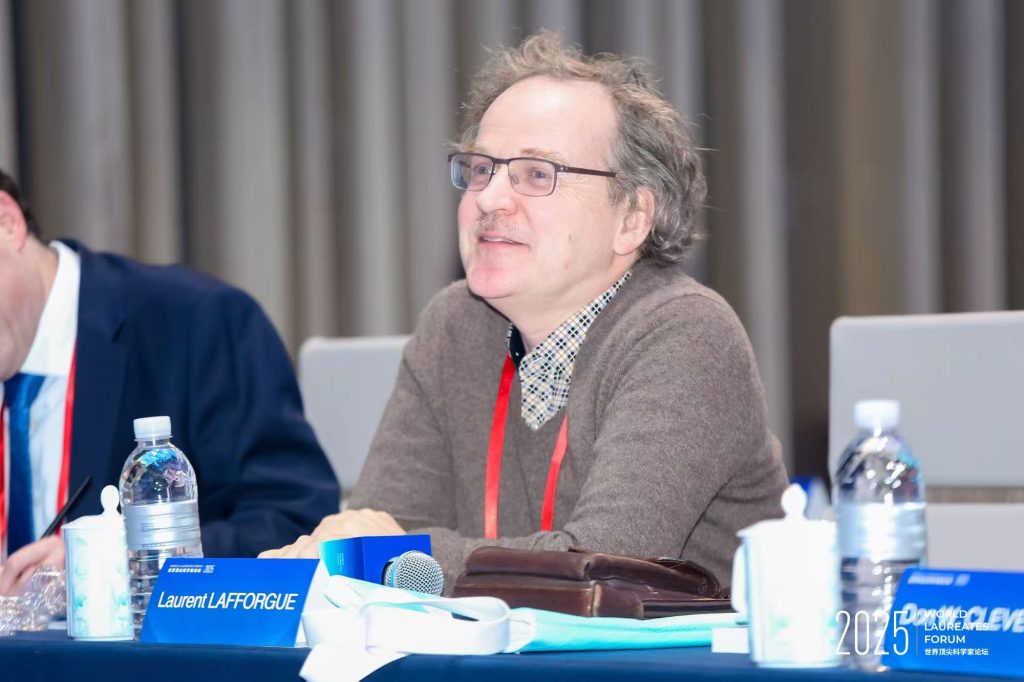
Laurent LAFFORGUE, recipient of the 2002 Fields Medal and member of the French Academy of Sciences.
He exchanged six years of silence for a single mathematical theorem, and devoted the wonder of the second half of his life to a discipline neglected by mainstream academia for more than sixty years: Alexandre GROTHENDIECK’s theory of topoi.
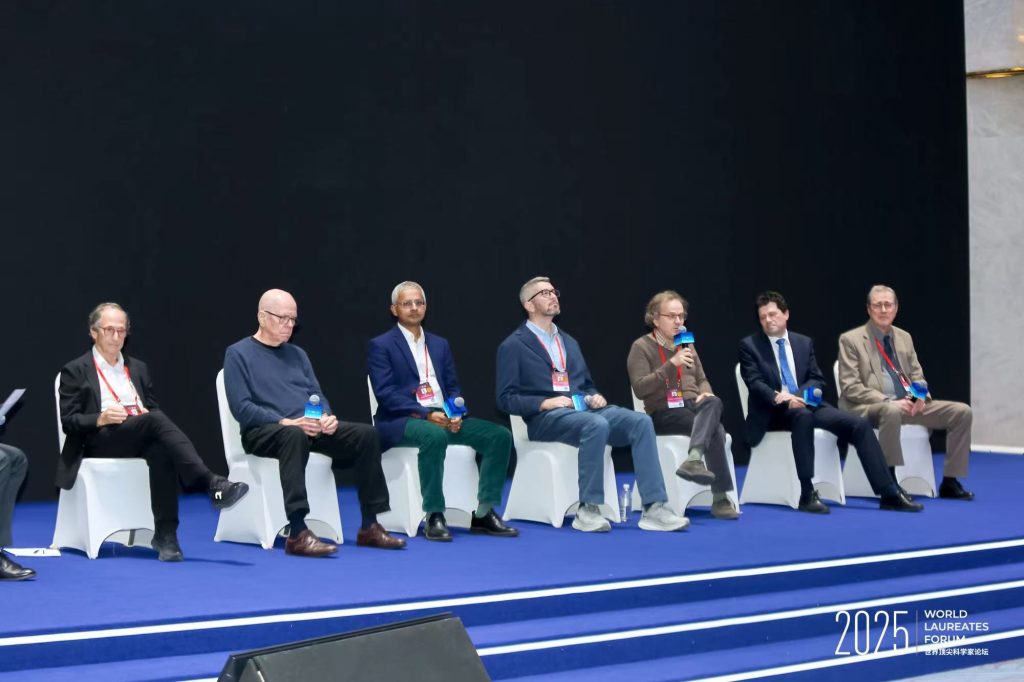
Shanghai Lingang, 2025 World Laureates Forum Youth Scientists Conference. During the SharpMind Roundtable Dialogue, LAFFORGUE engaged in conversation with young scientists from around the world. When asked what advice he would offer the younger generation, he replied:
“Give young people sufficient time to explore new ideas and new methods.”
Journey to the Temple of Mathematics
LAFFORGUE was born in 1966 in the southern suburbs of Paris. His mathematical talent emerged early: as a teenager, he won silver medals in the International Mathematical Olympiad for two consecutive years. In 1986, he entered the École Normale Supérieure, embarking on the most elite trajectory of French mathematics.
In 2002, at the age of 35, LAFFORGUE reached the highest stage in the discipline when he was awarded the Fields Medal. His prize-winning work established the Langlands correspondence for the general linear group GLr, over function fields. As many mathematicians observed, “Drinfeld’s proof was already extraordinarily difficult, while Lafforgue’s achievement was a feat of an entirely different scale, extending across hundreds of pages.”
The Langlands program has often been described as a “grand unified theory” of mathematics, seeking deep connections between number theory and harmonic analysis. LAFFORGUE not only achieved a decisive breakthrough, but also carried forward the work of two previous Fields Medalists, Pierre DELIGNE and Vladimir DRINFELD. The honor was unquestionably deserved.
Yet it soon became clear that this young Fields Medalist had no intention of remaining solely within the ivory tower.
A Lonely “Revolt”
After achieving international recognition, LAFFORGUE made a move that surprised many observers: he began openly criticizing the state of French primary and secondary education.
The turning point was a petition protesting the sharp reduction of Greek and Latin in school curricula. “Greek and Latin are only the tip of the iceberg,” LAFFORGUE argued. “The teaching of French itself is already in serious danger.” As he immersed himself in educational literature, he came to realize how profoundly French schools had changed since his own childhood.
In 2005, French President Jacques CHIRAC appointed him to the National Council for Higher Education. Yet only one day later, he was forced to resign. The reason was a sharply worded letter in which he questioned whether the council truly intended to reform education, or whether it would continue relying on the same “experts” who, in his view, had already led the system into crisis.
To LAFFORGUE, students are the primary victims of this collapse, while teachers themselves also suffer within the system. He firmly believes that children must genuinely understand arithmetic operations rather than simply rely on calculators. “The calculations students learn become nourishment for the mind,” he argued. “Calculations delegated entirely to machines awaken no human potential.”
His remarks sparked intense controversy at the time, yet he never retreated from his position.
“SharpMind Roundtable Dialogue” at the Youth Scientists Conference
Forgotten for sixty years, the topos — Huawei caught it.
Few could have predicted LAFFORGUE’s next step: he would become a passionate advocate of the theory of topoi.
Originally developed more than sixty years ago by Alexandre GROTHENDIECK, one of the greatest mathematicians of the twentieth century, the theory of topoi was regarded by GROTHENDIECK himself as profoundly important. Yet for decades it was met within academia with indifference, and at times even hostility. In an interview, LAFFORGUE remarked: “Grothendieck spent hundreds of pages explaining the importance of topoi, and the academic community simply did not respond. To me, that was absolutely astonishing.”
What surprised him even more was the stark contrast between academic skepticism and industrial enthusiasm.
“I found far more receptive listeners among engineers, specifically at Huawei France,” he explained. In 2021, LAFFORGUE formally joined the Huawei Paris Research Center. Many engineers there believed that the theory of topoi could potentially provide a mathematical foundation for artificial intelligence, offering forms of interpretability and formal logical structure that current deep learning methods struggle to achieve.
At Huawei, LAFFORGUE finally found an environment where he could devote himself to advancing a theory that had existed for sixty years, yet which few had dared to explore in depth.
A Lifelong Chinese Connection
LAFFORGUE has long shared a deep connection with China. In 2002, it was at the International Congress of Mathematicians in Beijing that he received the Fields Medal. Since then, he has frequently returned to China for academic exchange.
In October 2025, LAFFORGUE visited Beijing Foreign Studies University and delivered a lecture titled “Mathematics: An Experience of Internationalism.”
At the Chern Lecture hosted by Nankai University, he presented a talk entitled “What Is a Point? What Is Space?” In the lecture, he proposed a novel perspective: that a real number can be understood as a logically consistent system of answers to questions about whether a number belongs to a given interval.
In recognition of his outstanding contributions to the cultivation of mathematical talent and the advancement of scientific research in China, LAFFORGUE received the Chinese Government Friendship Award in 2025.
临港的声音
At the 2025 World Laureates Forum, LAFFORGUE once again stood beneath the spotlight. Yet rather than speaking about his latest theorems, he repeatedly emphasized one idea: give young people time.
His own life is perhaps the strongest testament to this belief. It took him six years to resolve major problems connected to the Langlands program, and more than a decade to advance the theory of topoi. Truly transformative discoveries are rarely recognized immediately. What scientists need is not merely short-term funding, but sufficient time to prove the value of an idea.
From Paris to Shanghai, from member of the French Academy of Sciences to mathematician at a Huawei research laboratory, LAFFORGUE has followed a path few could replicate. Whether Alexandre GROTHENDIECK foresaw the future of artificial intelligence sixty years ago may never be known. But through his work, LAFFORGUE demonstrates that true scientists have always been idealists.
And at the Forum in Lingang, he solemnly passed that spirit of idealism on to the next generation.

