


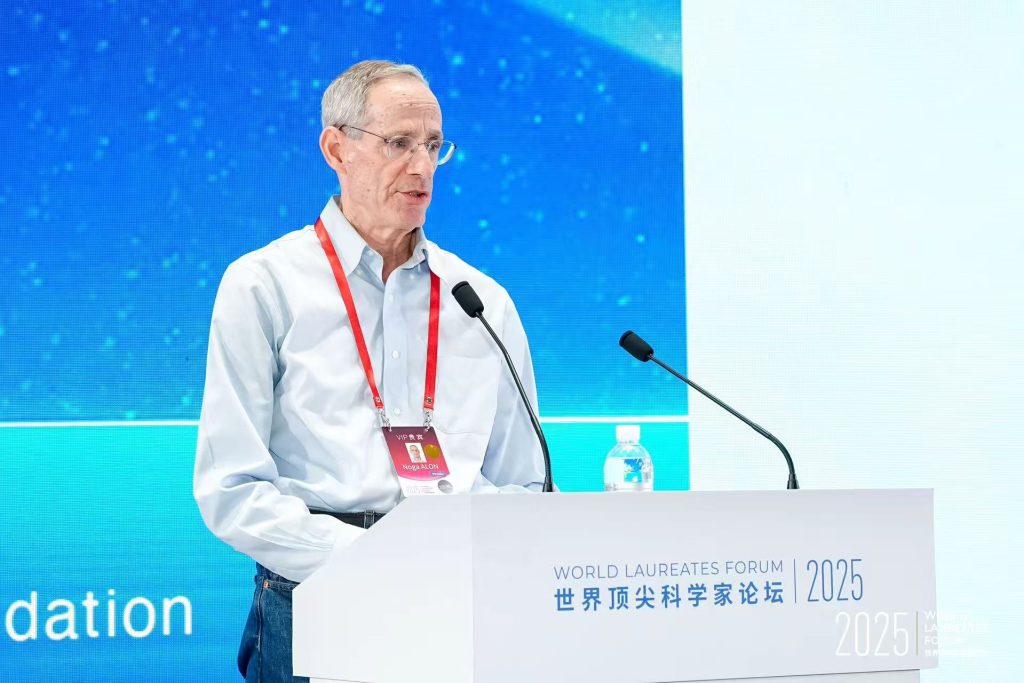
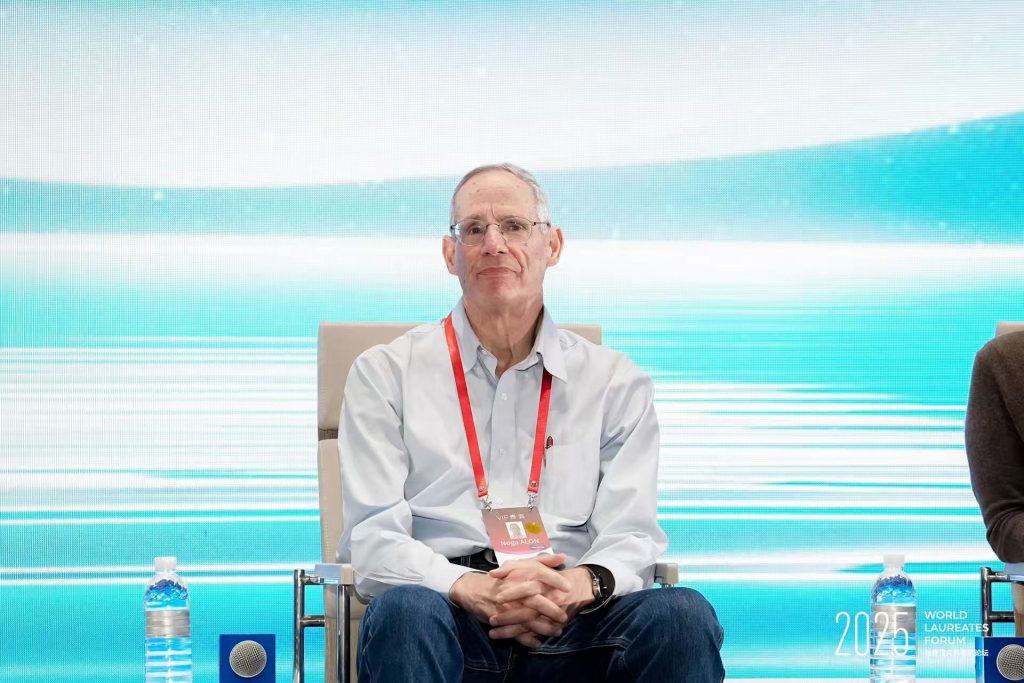
At the Shanghai Lingang venue of the 2025 World Laureates Forum, a scholar in a dark suit leans slightly forward, quietly listening to a question from a young scientist. His gaze is gentle, his demeanor composed, as if time itself has slowed in his presence. This first-time participant is Noga ALON, recipient of the 2024 Wolf Prize in Mathematics and Professor of Mathematics at Princeton University.
The Academic Journey of a Mathematical Master
Noga ALON was born in 1956 in Haifa, Israel. From an early age, he was naturally drawn to mathematical puzzles. “The beauty and elegance of mathematics attracted me very early on,” he recalled in a 2021 interview with the European Journal of Combinatorics. “It strives for an objective and absolute truth.” During high school, he encountered a deeply influential teacher, Yaakov KAPLAN, and distinguished himself in national mathematics competitions. Remarkably, he also met the legendary mathematician Paul ERDŐS while still in high school. A problem in extremal graph theory posed to him by ERDŐS later became ALON’s first academic paper and laid the foundation for his master’s thesis.
ALON received his bachelor’s degree from the Technion – Israel Institute of Technology, his master’s degree from Tel Aviv University, and his Ph.D. from the Hebrew University of Jerusalem under the supervision of Micha PERLES. He subsequently held visiting or research positions at leading institutions including the Massachusetts Institute of Technology, Harvard University, the Institute for Advanced Study, and Bell Laboratories. He joined Tel Aviv University in 1985 and served as Dean of the School of Mathematical Sciences from 1999 to 2001. In 2018, he moved to Princeton University, where he continues to teach and conduct research. He has published more than 850 academic papers, supervised over fifty doctoral students, and co-authored the influential textbook The Probabilistic Method with Joel SPENCER, a foundational work in modern combinatorics.
Intelligent Science Conference: Frontier Thinking in Combinatorics
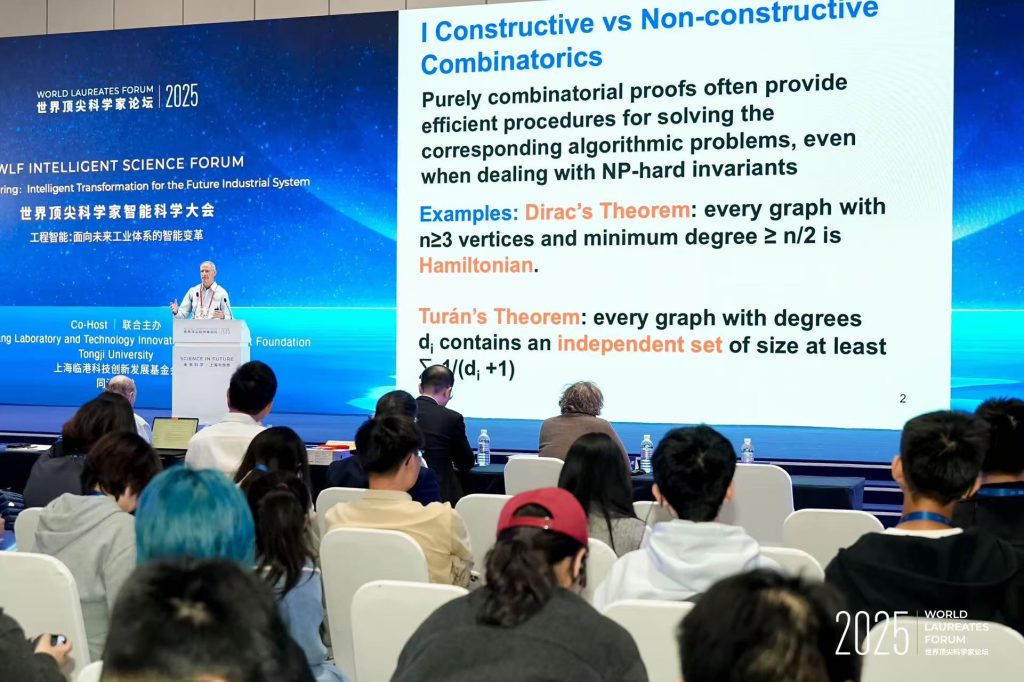
On October 25, 2025, the Intelligent Science Conference, jointly organized by the Shanghai Lingang Science and Technology Innovation Development Foundation and Tongji University, was held at the Shanghai Lingang Center. Under the theme “Engineering Intelligence: Intelligent Transformation for Future Industrial Systems,” the conference brought together Turing Award, Fields Medal, and Wolf Prize laureates, along with leading scholars from around the world. Noga ALON made his first appearance at the Forum and delivered a keynote lecture.
At the conference, ALON pointed out that many applications of topological and algebraic methods in combinatorics still rely on non-constructive proofs. The challenge of making these results algorithmic, he noted, has become a major frontier in contemporary mathematical research, with initial progress already underway.
His remarks aligned closely with the Forum’s broader theme of connecting fundamental research with real-world applications. Sharing the stage with ALON were leading scientists including Martin E. HELLMAN, recipient of the 2015 Turing Award, and Jack J. DONGARRA, recipient of the 2021 Turing Award, and Laurent LAFFORGUE, recipient of the 2002 Fields Medal. LAFFORGUE discussed the relationship between artificial intelligence and mathematics, noting that current AI technologies are opening up a new paradigm for mathematics and science, while at the same time requiring mathematical methods to improve their performance and reliability.
As a scholar working across pure mathematics and computer science, ALON has consistently emphasized that the boundary between pure and applied mathematics is both blurred and constantly evolving. “I enjoy working on interesting mathematical problems without worrying too much about whether they have practical applications,” he remarked in an earlier interview. “If some of my work turns out to have applications, I consider that a bonus.” This perspective is also reflected in his research on streaming algorithms, where the eventual practical impact has far exceeded the original theoretical motivation.
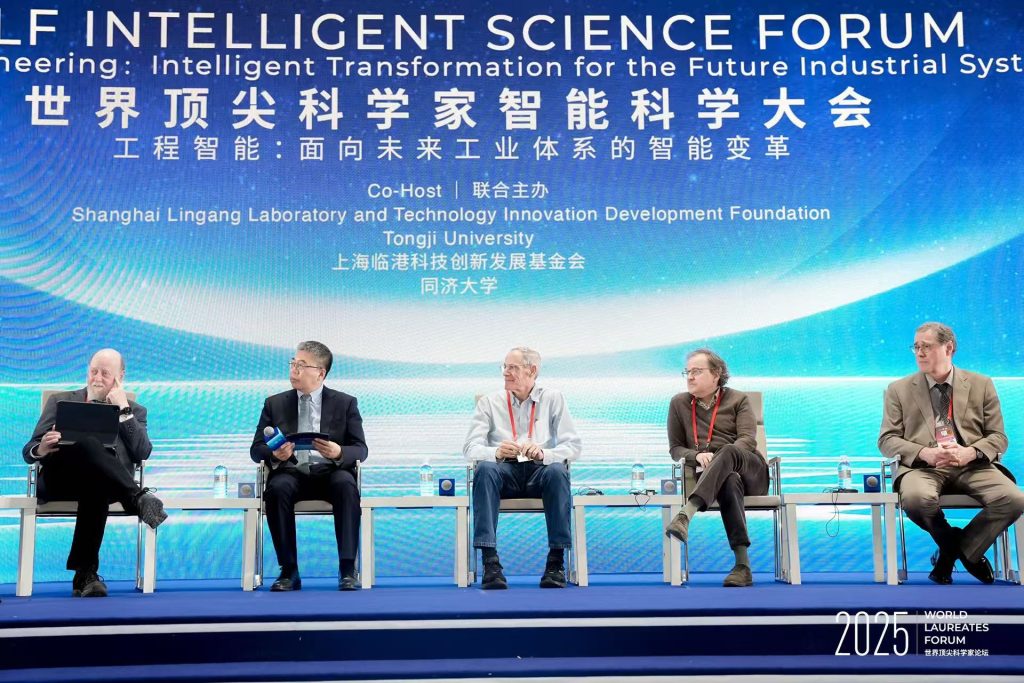
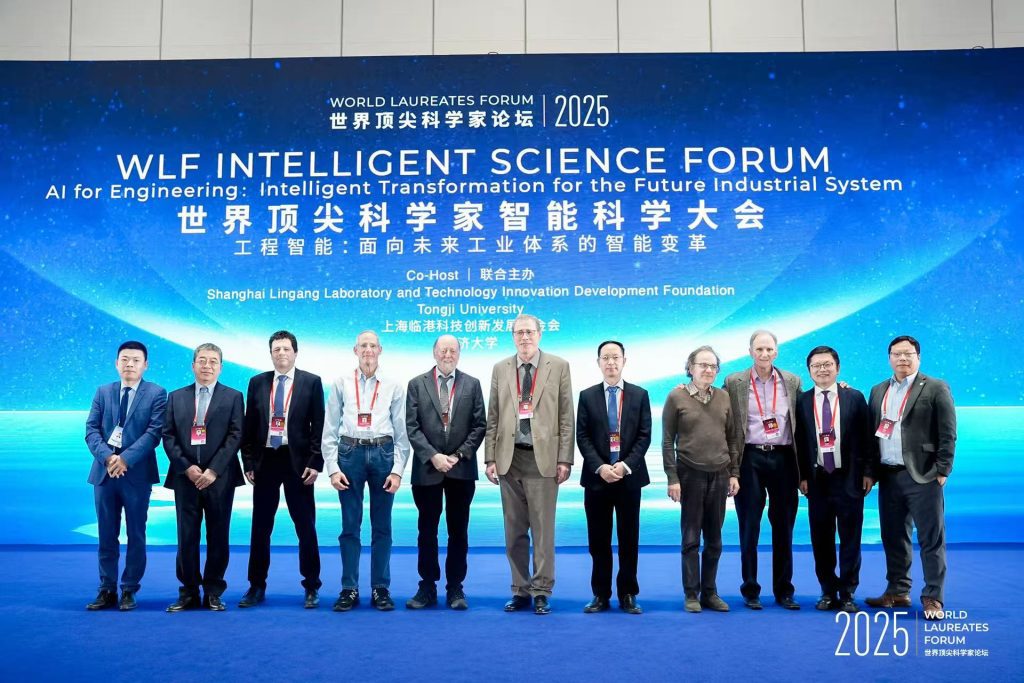
Intelligent Science Conference of the 2025 World Laureates Forum
Contributions That Reshaped Mathematics: Six Milestones
Noga ALON’s research is both broad and profound. The Wolf Prize Committee recognized him “for his pioneering contributions to combinatorics and theoretical computer science.” The following six areas are among his most celebrated achievements:
Combinatorial Nullstellensatz
Building on Hilbert’s Nullstellensatz from algebraic geometry, ALON developed a powerful algebraic tool tailored to discrete problems. It has had major applications in graph theory, combinatorics, and additive number theory.
Expander Graphs and Spectral Methods
In collaboration with Vitali MILMAN and others, ALON established deep connections between the expansion properties of graphs and their spectral characteristics. Expander graphs have since become fundamental tools in algorithm design, error-correcting codes, and pseudorandomness.
Streaming Algorithms and Sketching Techniques
In a landmark 1999 paper with Yossi MATIAS and Mario SZEGEDY, ALON pioneered the study of data stream algorithms. Their work addressed how to sample and estimate properties of massive data streams under strict memory constraints, with wide applications in network monitoring, database systems, and natural language processing.
Resolution of the Hadwiger–Debrunner Problem
Together with Daniel KLEITMAN, ALON solved this classical problem in combinatorial geometry, first posed in 1957. Their result significantly extended Helly’s theorem and had lasting influence in the field.
Refutation of a Conjecture by Claude SHANNON
ALON disproved a conjecture proposed by Claude SHANNON in 1956, showing that the Shannon capacity of the disjoint union of two channels can exceed the sum of their individual capacities. This result reshaped the direction of research in information theory.
A Foundational Text on the Probabilistic Method
His book The Probabilistic Method, co-authored with Joel H. SPENCER, is widely regarded as a classic and has trained generations of researchers in combinatorics and theoretical computer science.
Think About Interesting Problems: Simple Advice for Young People
As a mentor who has supervised more than fifty PhD students, Noga ALON offers advice to young scientists that is both simple and profound. In his Shaw Prize acceptance speech, he once said, “My scientific credo has always been to think about interesting things.” In a 2021 interview, he further explained, “Think about problems and areas that you find interesting, rather than deliberately searching for what is considered ‘important.’ The key to success is passion for your field. Also, try to learn as much mathematics as possible at an early stage. It becomes much harder to learn new areas later, and a solid mathematical foundation is essential.”
When asked about the future directions of combinatorics, he emphasized its close ties with theoretical computer science. He noted that algorithmic perspectives, computer-assisted proofs, and deeper integration with algebra and number theory will be major trends over the next two decades. At the same time, he stressed, “Mathematics should be viewed as a unified whole, and we should not try to separate important fields from less important ones.”
Beyond mathematics, Noga ALON enjoys reading, traveling, and playing table tennis. He jokes that his skills are “not particularly strong, but I play with great enthusiasm.” He and his wife Nurit have three daughters, and in his Shaw Prize biography he wrote, “I am especially grateful for their love and support.”
In 2022, Noga ALON was awarded the Shaw Prize in Mathematical Science. In 2024, he and Adi SHAMIR jointly received the Wolf Prize in Mathematics. Despite these honors, he remains actively engaged in research, “I have been fortunate to collaborate with many outstanding researchers… and I hope to continue working with them to explore fascinating problems in discrete mathematics and its applications.”
Noga ALON’s first appearance at the Forum leaves a distinctive note in this global scientific dialogue. As 2013 Nobel Laureate in Chemistry Michael LEVITT once said, “We have every reason to be optimistic.” This optimism stems not only from the progress of science itself, but also from explorers like Noga ALON, who remain driven by passion and curiosity.
Shanghai Lingang is steadily becoming a vital hub connecting China with the world’s leading scientific communities. Noga ALON’s engagement with Lingang adds yet another solid pillar to this bridge.

