


>Under the spotlight of the 2025 World Laureates Forum, a silver-haired professor stepped forward to receive the Intelligent Science or Mathematics Prize. As his hands touched the medal symbolizing scientific honor, it seemed as though they were still gripping the steering wheel of the old tractor he once drove on an Ohio farm.
October 2025, in Shanghai Lingang, aound 150 leading scientists from across the world gathered at the World Laureates Forum, including four Nobel laureates, four Turing Award laureates, and sixteen academicians of the Chinese Academy of Sciences and the Chinese Academy of Engineering.
Among this constellation of scientific minds, one figure drew particular attention: the 75-year-old mathematician Richard SCHOEN, Emeritus Professor at the School of Humanities and Sciences at Stanford University. For his foundational contributions to geometric analysis and differential geometry, he was awarded the 2025 World Laureates Association Prize in Intelligent Science or Mathematics.
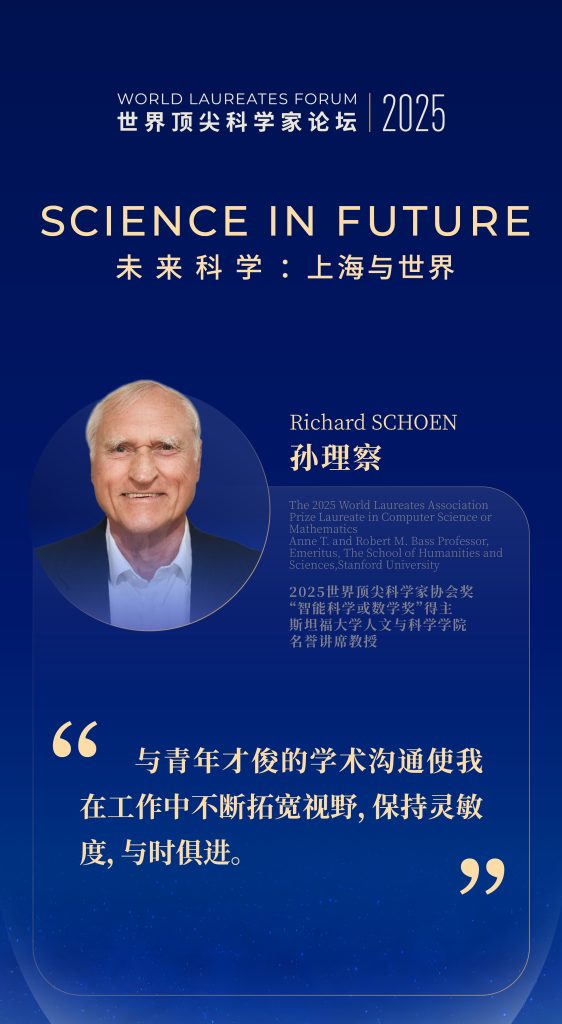
Chapter 1
A Thinker from the Farm
Richard SCHOEN was born in 1950 on a farm in Celina, Ohio, the tenth of thirteen children. Much of his childhood was spent doing farm work, especially driving a tractor across the fields, an experience he later described as “a perfect solitary time for thinking.”
An academic atmosphere quietly nurtured his mathematical curiosity. His mother encouraged her children to pursue education, while his father enjoyed inventing and building things. Two of his older brothers, Hal and Jim, studied mathematics. Together, these influences laid the groundwork for Schoen’s future academic path.
In 1972, he graduated summa cum laude from the University of Dayton and received a graduate fellowship from the U.S. National Science Foundation. Five years later, he earned his Ph.D. at Stanford University under Leon SIMON and Shing-Tung YAU, beginning a career that would reshape modern mathematics.
Chapter 2
An Interpreter of the Universe’s Structure
By the late 1970s, the boundary between physics and mathematics was becoming increasingly blurred in Schoen’s work. In 1979, together with Shing-Tung YAU, he completed the landmark proof of the Positive Mass Theorem.
This achievement provided rigorous mathematical confirmation of a profound physical principle: any isolated gravitational system must possess non-negative total energy. The result not only offered a solid mathematical foundation for understanding the structure of the universe but also became a model of interdisciplinary collaboration between geometric analysis and mathematical physics.
Their collaboration has often been described as a “perfect fusion of geometric brilliance and deep physical insight.” Originating from studies of stable minimal surfaces, the work ultimately offered mathematical support for fundamental laws governing the cosmos.
Chapter 3
Six Years of Perseverance
In mathematics, the most challenging problems often serve as tests of patience. Beginning in 1978, Schoen devoted himself to the Yamabe problem on compact manifolds, a profound question concerning constant scalar curvature that had perplexed mathematicians for decades.
After six years of sustained effort, he finally solved the problem in 1984.
By creatively applying the Positive Mass Theorem from physics to geometry, Schoen resolved one of the field’s most celebrated problems. The significance of this result lies in its establishment of nonlinear partial differential equations as a central force in geometric research, opening new directions for generations of mathematicians.
In recognition of this foundational contribution, the American Mathematical Society awarded him the Bôcher Memorial Prize in 1989.
Chapter 4
Three Academic Milestones
In 2007, Richard SCHOEN and Simon BRENDLE jointly proved the Differentiable Sphere Theorem, bringing closure to a conjecture that had guided the development of differential geometry for half a century.
1979 — Proof of the Positive Mass Theorem
Revealed the non-negative energy property of isolated gravitational systems
Established a foundation for interdisciplinary research between mathematics and physics
1984 — Resolution of the Yamabe Problem
Opened new geometric applications of nonlinear partial differential equations
Awarded the Bôcher Memorial Prize in 1989
2007 — Proof of the Differentiable Sphere Theorem
Completed the geometric characterization of spheres
Achieved jointly with Simon BRENDLE
Schoen’s academic influence extends far beyond these milestones. From curvature estimates for stable minimal surfaces to the regularity theory of harmonic maps, his work spans multiple domains of mathematics, with each contribution becoming a foundational reference in its field.
Chapter 5
The World Laureates Association Prize
In 2017, Richard SCHOEN shared the Wolf Prize in Mathematics with Charles FEFFERMAN, and in the same year received several other major honors, including the Heinz Hopf Prize and the Lobachevsky Medal.
Eight years later, at the 2025 World Laureates Forum, he received the World Laureates Association Prize in Intelligent Science or Mathematics for “solving previously intractable problems through revolutionary theorems and creating mathematical tools that redefine the framework of geometric analysis.”
The Prize Selection Committee noted that Schoen “has inspired generations of geometers through his insightful teaching and pioneering research methods.” At the award ceremony, the 75-year-old mathematician reflected modestly,
“I feel deeply honored to stand among the remarkable scholars who have received this prize before me.”
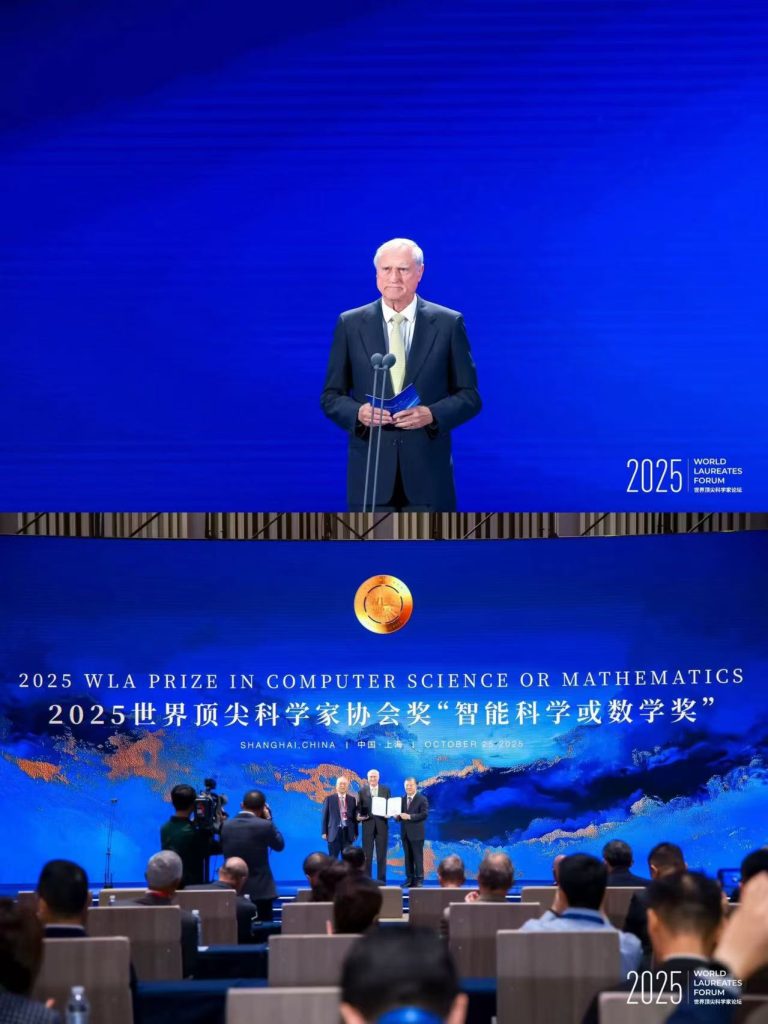
Richard SCHOEN receiving the 2025 World Laureates Association Prize in Intelligent Science or Mathematics
Chapter 6
Slowing Down to Cultivate the Next Generation
“Only by slowing down can one achieve depth in scholarship.” This phrase, often repeated by Richard SCHOEN, captures the essence of his approach to research and teaching. To his students, he is known as an extraordinarily diligent and humble mentor.
He arrives at his office at seven or eight each morning, often works on Saturdays, and prepares meticulously for every lecture, determined not to waste even a minute of his students’ time. While he never pressures students to publish quickly, he insists that doctoral theses meet the standards of top academic journals.
To date, Schoen has supervised more than fifty doctoral students, around twenty of whom are from China. Rather than organizing large group meetings, he prefers weekly one-on-one discussions with each student. He also supports their research and academic travel with his own funding.
His mentorship combines wisdom with generosity. He encourages young scholars to explore boldly and often insists that early-career researchers publish their first significant work under their own names, helping them establish independent academic identities.
This spirit of selfless mentorship has shaped a generation of mathematicians around the world. One of his former students, Duke University mathematician Hubert BRAY, once remarked, “Even with such remarkable achievements, Richard Schoen remains one of the hardest-working mathematicians I know.”
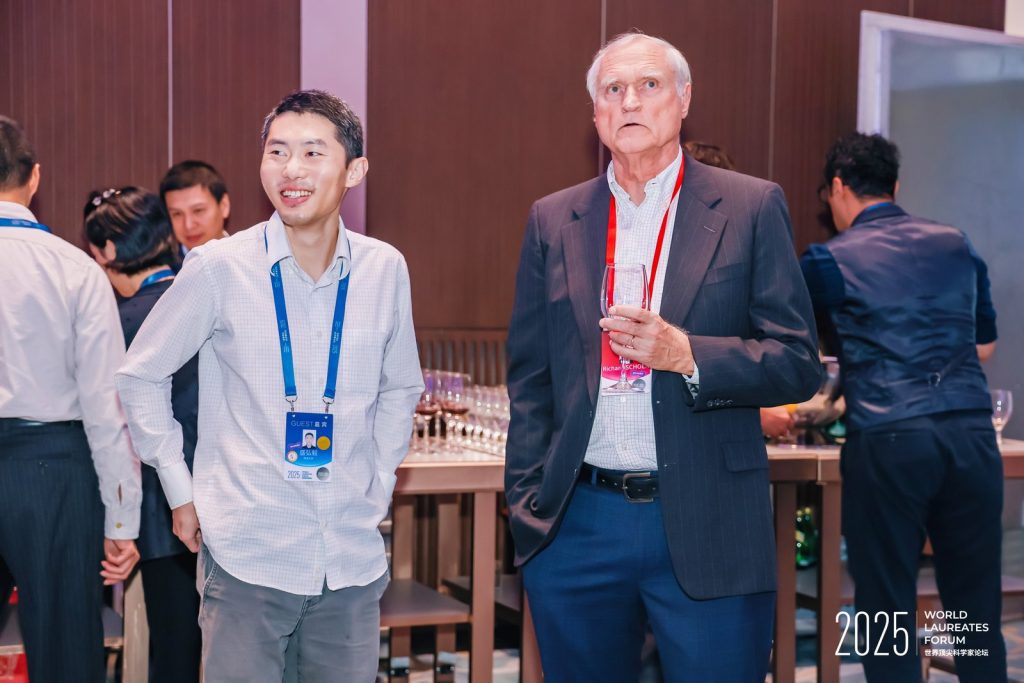
Professor Richard SCHOEN participating in WLF Möbius Night
Chapter 7
Inspiration in Motion
Few people know that this rigorous mathematician is also an enthusiastic sportsman. In his youth, standing nearly 1.9 meters tall, he excelled at baseball and basketball and was even capable of slam dunks.
Now in his seventies, he still plays tennis twice a week and often asks his students about their own athletic activities. To him, exercise is not only a way to relieve stress but also a source of conversation and inspiration.
“Mathematics requires patience. You must be able to accept being stuck,” Schoen explains, “But conversations with others and maintaining a passion for life often lead to new insights.” This balance between work and life has made his scientific journey both steady and fulfilling.
Chapter 8
Lingang’s Academic Connection
As the host location of the 2025 World Laureates Forum, Lingang provided Professor Schoen with a new platform to deepen connections with the mathematical community in the East. His academic relationship with China has deep roots. He once recalled:
“My first visit to Shanghai was in December 1980, arranged by Professor Gu CHAOHAO and Professor Hu Hesheng.”
His most recent visit before the Forum was in spring 2018. Reflecting on his return in autumn 2025, he noted, “I very much look forward to seeing how the city has changed since 2018.” During the Forum, he not only attended the award ceremony in Lingang but also participated actively in academic exchanges. At a conference hosted by the Shanghai Institute for Mathematics and Interdisciplinary Sciences, he even celebrated his 75th birthday.
Lingang has witnessed the decades-long mentor-student relationship between Schoen and Shing-Tung YAU and has also become a place where he engages with young scholars on equal footing, inspiring future generations. This academic bond forged in Lingang further deepens his connection with the Chinese mathematical community, allowing the spirit of “scholarship without borders and relentless pursuit of knowledge” to take root on this forward-looking land.
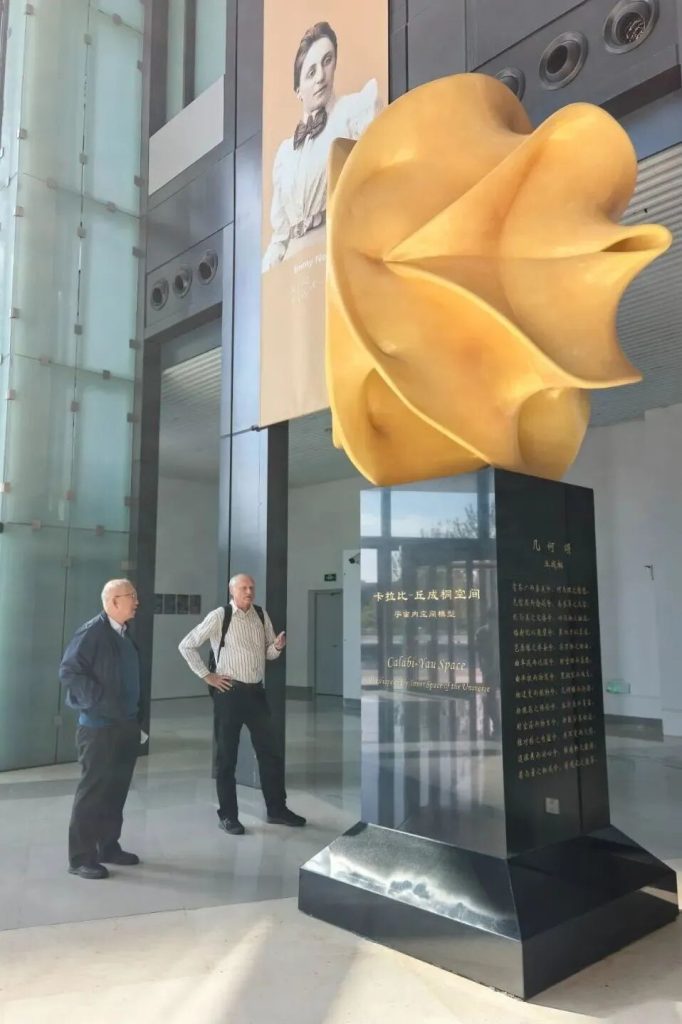
Professor Shing-Tung YAU with Professor Richard SCHOEN
A tractor moves slowly across the fields of Ohio. Decades later, a 75-year-old mathematical master receives a scientific award in Shanghai Lingang. Between these two images lies half a century of relentless pursuit of mathematical truth.
At this grand scientific gathering organized by the Shanghai Lingang Science and Technology Innovation Development Foundation, Professor Richard SCHOEN demonstrates that in an era obsessed with speed, the deepest scientific breakthroughs often emerge from minds willing to slow down.
What he leaves us is not only a mathematical universe still expanding, but also a lesson more valuable than any theorem: the true spirit of science lies in an enduring curiosity about the unknown and an infinite patience in the search for truth.

