


> At six o’clock every morning, a 76-year-old mathematician dives into the pool, beginning his day with a 1,500-meter swim. Rain or shine, this routine has endured for decades, an embodiment of discipline, patience, and quiet perseverance.
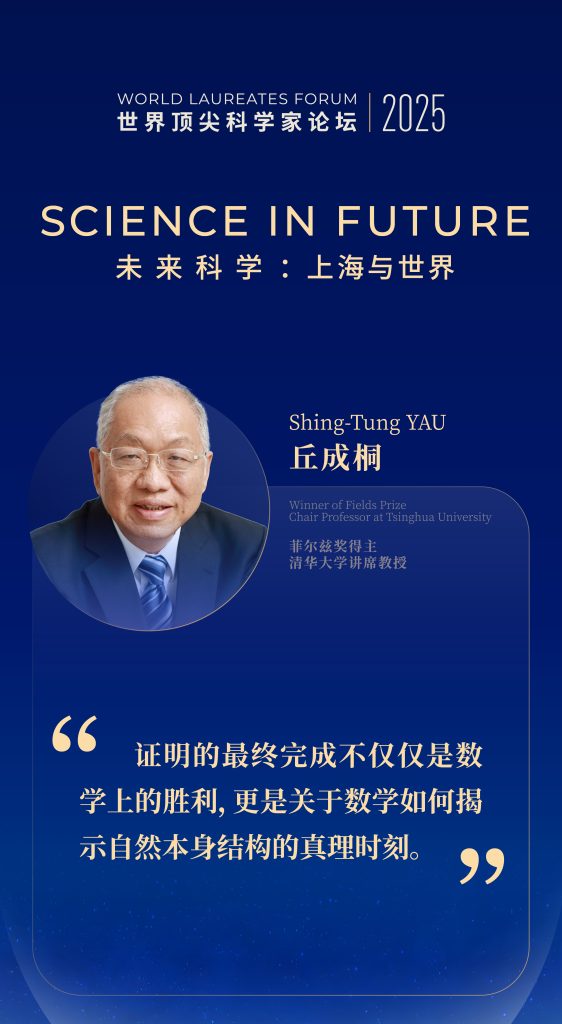
In 2025, the World Laureates Forum convened in Lingang, where the world’s leading scientific minds gathered to exchange ideas. It was here that mathematician Shing-Tung YAU personally presented the World Laureates Association Prize in Intelligent Science or Mathematics to his longtime collaborator, close friend, and former student, Richard SCHOEN, Honorary Chair Professor at Stanford University.
Their half-century partnership and friendship became one of the Forum’s most moving moments. On this vibrant scientific frontier in Lingang, YAU drew upon his own experience to encourage Chinese scholars to adopt a more open mindset, to “dismantle academic walls” and broaden their global horizons.
A World Laureates Forum Moment
Under the spotlight, amid a hushed audience, YAU spoke with composure and deep emotion, “Personally, I feel an immense sense of honor and genuine joy to present the 2025 World Laureates Association Prize in Intelligent Science or Mathematics to Professor Richard Schoen.”
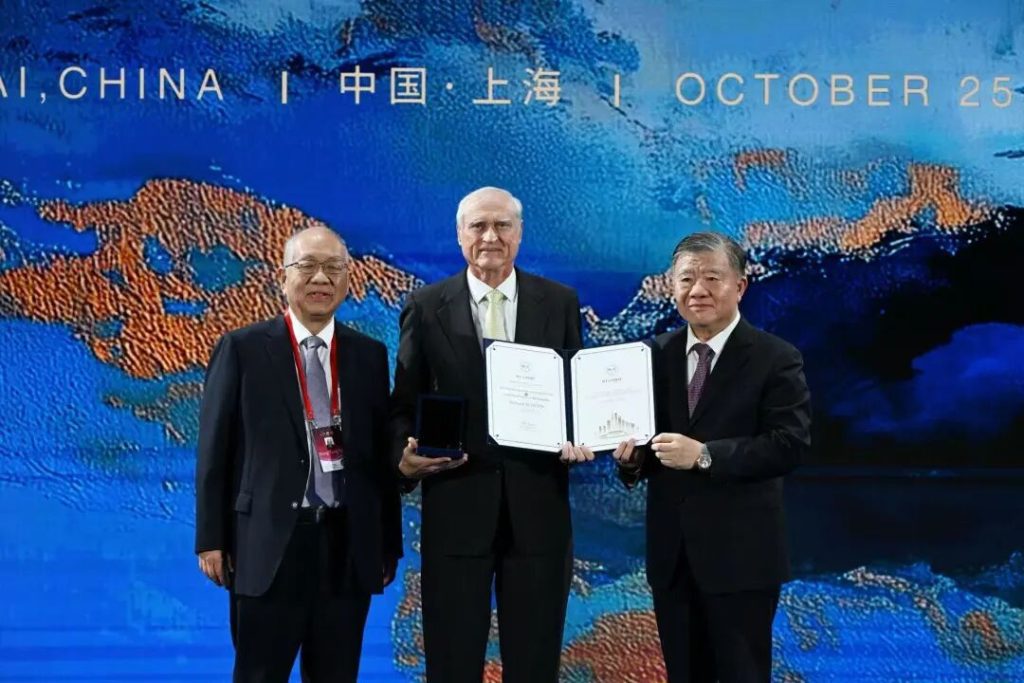
Shing-Tung YAU (left), 1982 Fields Medal
Richard SCHOEN (center), recipient of the 2025 World Laureates Association Prize in Intelligent Science or Mathematics; Honorary Chair Professor, School of Humanities and Sciences, Stanford University
ZHU Chen (right), Academician of the Chinese Academy of Sciences
Introducing the awardee, YAU spoke with warmth, “Professor Schoen is not only an outstanding mathematician, he is my former student, my long-term collaborator, and a dear friend.”
His remarks traced five decades of shared academic history. He recalled witnessing Schoen’s growth “from a young scholar of quiet determination and deep ideas into one of the truly great geometers of our time.”
When SCHOEN first joined Stanford in the 1970s to work with YAU, geometric analysis was only just beginning to take shape. At that time, YAU noted, “geometry and analysis were often regarded as two separate disciplines and two different worlds.”
Memories of Collaboration
YAU paid special tribute to their joint work on the Positive Mass Theorem in general relativity.
“This was a problem that had troubled physicists and mathematicians since the time of Einstein,” he recalled, “We spent many intense years trying to understand how geometry could capture the idea that the total energy of an isolated physical system should never be negative.”
Those days of shared struggle remain vivid, “I still remember the long nights at the blackboard, when our discussions continued until dawn.” YAU admired SCHOEN’s composure and perseverance, “Especially the calm, unwavering focus he brought when assembling the analytical and geometric parts of the proof.”
When the proof was finally completed, it was more than a mathematical triumph, it was a profound moment revealing how mathematics can illuminate the structure of nature itself.
Academic Legacy
For YAU, students’ independent thinking matters more than their accolades. He recalled his own youth studying under Shiing-Shen CHERN, “Professor Chern initially asked me to work on the Riemann Hypothesis, but I wasn’t particularly interested.”
Unexpectedly, CHERN respected his choice and allowed him to pursue the Calabi Conjecture, a decision that would later define YAU’s career. Today, YAU has passed on this same academic freedom to younger generations.
He has supervised more than 70 doctoral students, many of whom are now central figures in mathematics worldwide. SCHOEN himself went on to achieve landmark results independently, solving the Yamabe problem, contributing to the Differentiable Sphere Theorem, and making foundational advances in harmonic maps and minimal surface theory.
YAU reflected, “Today, as his former advisor, I feel both proud and humbled. It is rare for a teacher to see a student exceed all expectations and redefine a field with such elegance.”

Shing-Tung YAU in conversation with young scientists at the 2025 World Laureates Forum, WLF Möbius Night
Reflections on Education
YAU has long held distinctive views on mathematics education in China. Observing that many parents steer children toward “popular” majors, believing mathematics leads to hardship and limited prospects, he expressed deep concern. He urged students to ask questions boldly rather than chase standard answers.
When his grandson asked for advice on choosing a field of study, YAU replied, “Keep an open mind. Find what genuinely interests you, and don’t let others decide for you.” This philosophy mirrors his lifelong advocacy for intellectual freedom and exploratory research.
A Vision of a Mathematical Powerhouse
YAU’s efforts to bring the International Congress of Mathematicians to China began in the 1990s, when he described Chinese mathematics as “starting from almost nothing.” That effort culminated in the 2002 ICM in Beijing.
Looking ahead to the 10th International Congress of Chinese Mathematicians in 2026, YAU stated with confidence, “In the next five to ten years, China will certainly become a major mathematical power.” He observed that, unlike in earlier years when awardees were predominantly overseas scholars of Chinese origin, one-third of this year’s award recipients are now based in China. He likened the situation to filling the Three Gorges Reservoir, “Before the water level rises, you don’t see the flood—but that doesn’t mean the power isn’t there.”
The metaphor captured both the present state and the latent momentum of Chinese mathematics.
Interdisciplinarity and Integration
In YAU’s view, mathematics is not only a foundational discipline but also a bridge connecting diverse scientific fields. In July 2025, his team and collaborators published groundbreaking work on glioma imaging genomics in Proceedings of the National Academy of Sciences (PNAS).
By applying differential geometry to medical imaging, they achieved a roughly 17% improvement in diagnostic accuracy, demonstrating the immense potential of mathematics-life science integration.
At the Shanghai Institute for Mathematics and Interdisciplinary Sciences, founded by YAU, 50% of research focuses on interdisciplinary work, 25% on pure mathematics, and 25% on applied mathematics. In the institute’s central plaza, Chinese-style water features flow gently over walls engraved with mathematical formulas. Nearby, a golden model of the Calabi–Yau manifold outlines an abstract six-dimensional structure, East and West, art and science, seamlessly intertwined.
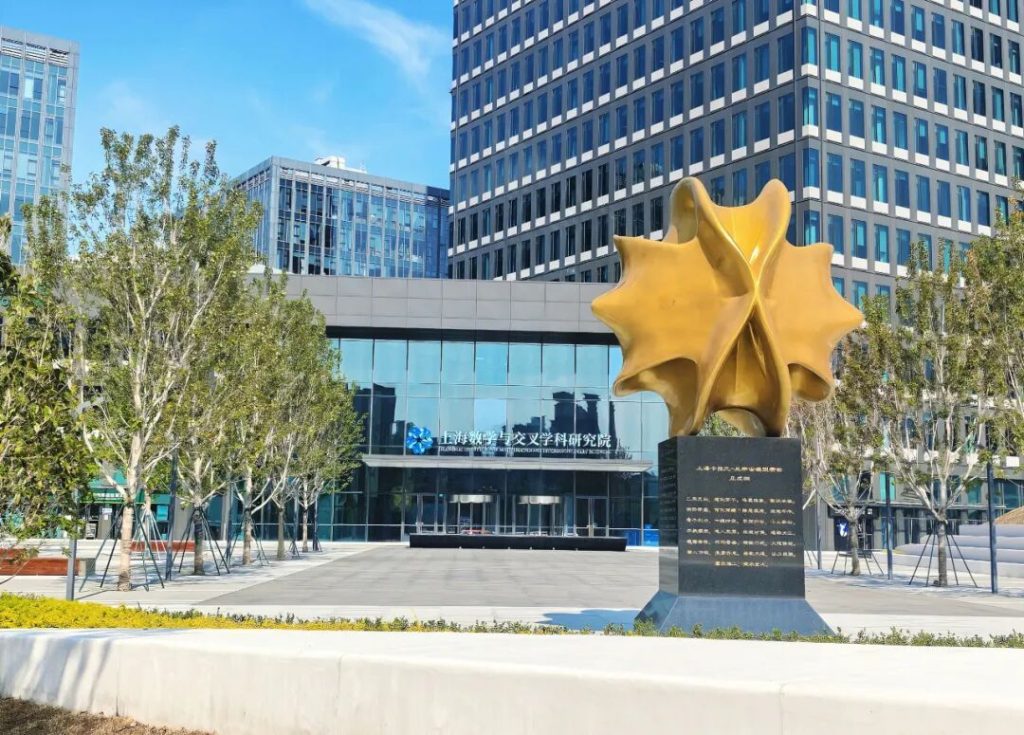
Calabi–Yau Square, Shanghai Institute for Mathematics and Interdisciplinary Sciences
At the 2025 World Laureates Forum in Lingang, YAU concluded, “Richard’s work has influenced not only geometry, but also physics, topology, and our philosophical understanding of space and curvature.”
As the award ceremony ended, the two scholars stood side by side. Behind them stretched Lingang’s open skyline and the ceaseless tide of the East China Sea, and its rhythm echoing a friendship forged over fifty years: refined by time, deepened through inquiry, and crystallized into an almost timeless guardianship of science.
At 76, Shing-Tung YAU still swims at dawn each day. This daily discipline is more than a personal ritual, it mirrors the spirit of Lingang itself: facing the sea, greeting each new tide and sunrise, and believing in the power of sustained effort. It symbolizes a shared conviction: whether advancing mathematics or cultivating a world-class international scientific community like Lingang, true breakthroughs are never achieved overnight. They require patience, resilience, and an open mind.
As an organizer of the World Laureates Forum, we have witnessed this firsthand in Lingang, and firmly believe that the solitude and long-term dedication demanded by top-level scientific thought find their ideal home in this calm yet vibrant innovation ecosystem, where global intellect and local cultivation converge and mutually nourish one another.

