


> In 1994, he discovered leptin, fundamentally reshaping the course of obesity research.
> Thirty-one years later, the “father of leptin” arrived in Shanghai Lingang and, for the first time at the 2025 World Laureates Forum, shared this decades-long journey of exploration. His account ranged from X-ray films developed late at night in the laboratory, to the global rise of GLP-1 therapies, and to a redefinition of the biological nature of obesity.


Top Scientist Speech: Craving Is Not a Weakness
At the Shanghai Lingang Center, Jeffrey M. FRIEDMAN delivered a keynote lecture titled “On the Causes and Treatment of Obesity: The End of the Beginning” at the Life Sciences Conference of the 2025 World Laureates Forum.
“We eat to obtain energy for sustaining life, movement, and thought,” he stated at the very beginning of his talk. “Signals of hunger and satiety are largely unconscious physiological responses, rather than something we can fully control. When you feel a craving, it may simply be a natural signal from your body that has been given an emotional label.”
Although these remarks may sound straightforward, they challenge a long-standing social belief. Before the discovery of leptin, obesity was widely attributed to laziness and a lack of willpower. FRIEDMAN’s research demonstrated that body weight is regulated by a highly sophisticated biological system, and that the key regulator of this system is leptin.
From “Gap Year” to the Path of Science
FRIEDMAN was born into an ordinary family in the suburbs of New York, where there was a common expectation: children with good academic performance would eventually become doctors. Following this path, he received his M.D. from Albany Medical College in 1977 and completed three years of residency training. However, during that period, he became increasingly aware that practicing medicine was not his true calling.
As his residency was coming to an end, his application for medical specialty training fell through after missing the deadline. A professor, sensing his potential interest in research, recommended him to spend a year in the laboratory of Mary Jeanne KREEK at Rockefeller University. “At the time, my plan was to do one year of research and then return to clinical medicine,” FRIEDMAN later recalled. That single year, however, would change the course of his life.
In 1981, FRIEDMAN began his doctoral studies at Rockefeller University, joining the laboratory of Jim DARNELL to study gene transcription in the liver. At first glance, this work seemed unrelated to obesity. Yet the molecular biology techniques he mastered during this period later proved essential in the eventual cloning of the ob gene. Alongside his doctoral research, he collaborated with SCHNEIDER and others, successfully cloning the CCK gene in 1983 and mapping it to mouse chromosome 9, thereby ruling out CCK as the causative gene for the ob phenotype.
In 1986, FRIEDMAN established his own laboratory at Rockefeller University and became an investigator at the Howard Hughes Medical Institute. He set his sights on identifying the ob gene using positional cloning. Reflecting on this decision, he later remarked: “In science, truly original ideas are rare. They often circulate within the community until someone commits fully to pursuing them. Success lies in recognizing a promising direction and following it with energy and determination.”
From the establishment of his laboratory to the eventual cloning of the ob gene, FRIEDMAN and his team spent nearly nine years on this endeavor.
Discovering Leptin
In December 1994, FRIEDMAN and his team published a landmark paper in Nature titled “Positional Cloning of the Mouse Obese Gene and Its Human Homologue.” Through large-scale genetic crossing experiments, the researchers gradually mapped the ob mutation to a region on chromosome 6. Within this region, they identified a gene that was expressed specifically in adipose tissue and found it to be defective in ob mice. Sequencing revealed that in the ob mouse genome, a premature stop codon appeared immediately after leucine at position 104. The team also sequenced this gene across multiple species, including humans, and found it to be highly conserved.
FRIEDMAN named the hormone encoded by this gene leptin, derived from the Greek word leptos, meaning “thin.” The name proved remarkably prescient. In 1995, his team further demonstrated in Science that the ob gene encodes a 16 kDa circulating protein. When this recombinant protein was administered to ob mice or even wild-type mice, both food intake and body weight were significantly reduced.
FRIEDMAN still vividly recalls the night of the discovery, “It was late one night in May when I developed the X-ray film and confirmed the finding. I realized what we had. It was a moment of insight. The data showed that the ob gene encodes a hormone that regulates food intake and body weight. At that moment, I felt it was extraordinary, one of the most important moments of my life. What you see are just spots, which are difficult for most people to interpret, but for those familiar with the technique, it reveals an elegant and simple biological system built by nature. That beauty was striking.”
The discovery of leptin fundamentally transformed the field of obesity research. Before the “leptin era,” obesity had long been regarded as a condition resulting from a lack of willpower to control diet and maintain exercise. FRIEDMAN’s work established a solid biological foundation for understanding the mechanisms of obesity and for developing potential treatments.
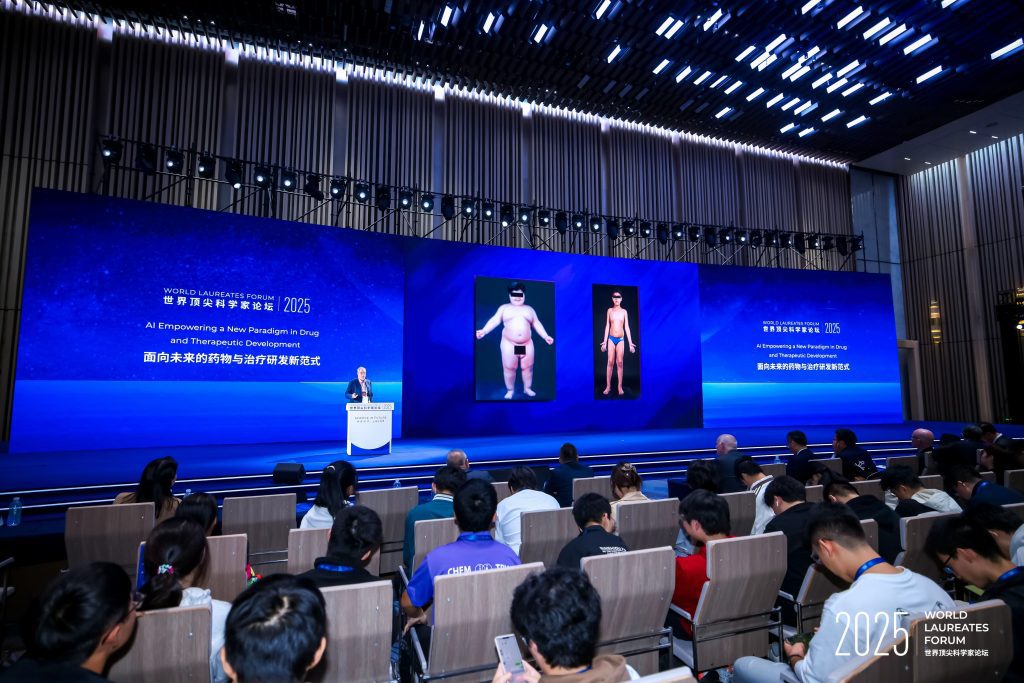
Life Sciences Conference of the 2025 World Laureates Forum
Not a Weight-Loss Wonder Drug, Yet It Transformed Medicine
Following the discovery of leptin, the pharmaceutical community held high expectations. The company Amgen acquired the rights for 20 million US dollars, hoping that administering recombinant leptin to obese patients would replicate the dramatic weight-loss effects observed in ob mice. However, as the first clinical studies were published, the reality became clear: for the vast majority of obese individuals, exogenous leptin was not an effective treatment for weight loss.
This outcome did not surprise FRIEDMAN. He had already recognized that most cases of obesity are not caused by leptin deficiency, but by leptin resistance, a condition in which the brain no longer responds effectively to leptin signals. He compared this phenomenon to type 2 diabetes. In type 1 diabetes, patients lack insulin, whereas in the more common type 2 form, insulin levels are elevated, leading to receptor desensitization. Similarly, when fat accumulation reaches a certain level and leptin levels remain chronically high, the brain gradually stops responding to leptin, making sustained weight loss difficult.
Yet the discovery of leptin was far from a failure. It enabled the precise mapping of complex neural circuits that regulate food intake and energy expenditure, and it accelerated the identification of multiple hormones involved in the central regulation of energy balance. Subsequent genetic studies revealed that up to 15 percent of individuals with severe obesity carry mutations in genes regulated by leptin.
One of the most important outcomes of this line of research is the development of GLP-1–based therapies. Although GLP-1 is not a primary driver of obesity, its pharmacological effects on neurons in the hypothalamus and brainstem, which are regulated by leptin, have so far produced some of the most significant advances in obesity treatment.
Latest Breakthroughs in Leptin
More than three decades after the discovery of leptin, FRIEDMAN’s laboratory continues to make significant advances. In 2025, his team at Rockefeller University published a study in Cell Metabolism that identified a key mechanism underlying leptin resistance and proposed a potential strategy to reverse it.
The study found that in states of leptin resistance, the levels of two essential amino acids, leucine and methionine, become dysregulated. Both are known activators of the mTOR signaling pathway. The researchers demonstrated that treatment with the drug rapamycin could restore leptin sensitivity in diet-induced obese mice, leading to a significant reduction in fat mass while having minimal effects on muscle. As the team noted, “This finding suggests that there may be ways to overcome leptin resistance, which is truly exciting.”
This work opens new directions for obesity treatment. FRIEDMAN has suggested that the future of the leptin system may not lie in its use as a standalone therapy, but in combination approaches. For example, pairing leptin with other hormones such as amylin may produce more substantial weight-loss effects.
The Future: Neural Circuits and Behavioral Decisions
Regarding the future of obesity research, FRIEDMAN emphasized that the central challenge lies in understanding how multiple feeding-related signals are integrated within the brain.
“Leptin acts on specific neuronal populations in the brain that regulate food intake. It inhibits neurons that promote feeding while activating those that suppress it,” he explained. “This allows us to map the detailed neural circuits that control eating behavior. The key question now is that, beyond leptin, there are many other inputs that influence feeding, such as smell, taste, and emotional states. How are these signals integrated to generate a behavioral decision, leading an organism to initiate or stop eating?”
He believes that as our understanding of leptin-regulated neural circuits deepens, new therapeutic strategies will inevitably emerge. The gap between advances in basic science and clinical applications, he suggests, will eventually be bridged by future breakthroughs.
“Don’t Be Too Hard on Yourself;
You’re Fighting a Powerful Biological System”
In his remarks at the 2025 World Laureates Forum, FRIEDMAN reiterated the biological basis of obesity. Held under the theme “Science in Future: Shanghai and the World,” the Forum brought together 25 laureates of major international prizes and around 150 scientists from more than ten countries. As one of the organizers, the Shanghai Lingang Science and Technology Innovation Development Foundation witnessed Professor FRIEDMAN’s first appearance at the Forum.


Drawing on twin studies, FRIEDMAN noted that genetics accounts for approximately 70 to 80 percent of body weight variation, second only to height. To a large extent, each individual’s weight range is biologically set. This means that, for most people, achieving an “ideal weight” is extremely difficult and not always necessary.
“If people are overweight or find it hard to lose weight, they should not be too hard on themselves,” he said. “They are fighting a powerful biological system. However, if someone is overweight and has diabetes or other complications, they should try to lose a modest amount of weight. Losing seven to ten pounds is often enough to improve health. The goal is not an ideal weight, but better health.”
When asked about his own weight management, he smiled and shook his head: “I wish I had a secret. I struggle with weight just like everyone else.” He is a passionate food lover, especially fond of Hunan cuisine, whose bold and spicy flavors, as he put it, are “hard to resist.”
For young researchers, he offered this advice: “I hope everyone in my lab takes as much initiative as possible in developing their own ideas and research directions. I tend to treat each person as an independent investigator who does not need to raise their own funding. When people feel a stronger sense of ownership over their work, they perform better, engage more deeply, and learn more.”
科学的起点与终点
From the landmark Nature paper published in 1994 to the stage of the 2025 World Laureates Forum in Shanghai Lingang, FRIEDMAN has spent thirty-one years demonstrating a simple yet profound truth: the value of science does not always lie in finding definitive answers, but in asking the right questions.
For example, who is to blame for obesity?
The answer is now clear: it is not your fault. It is biology speaking.

