


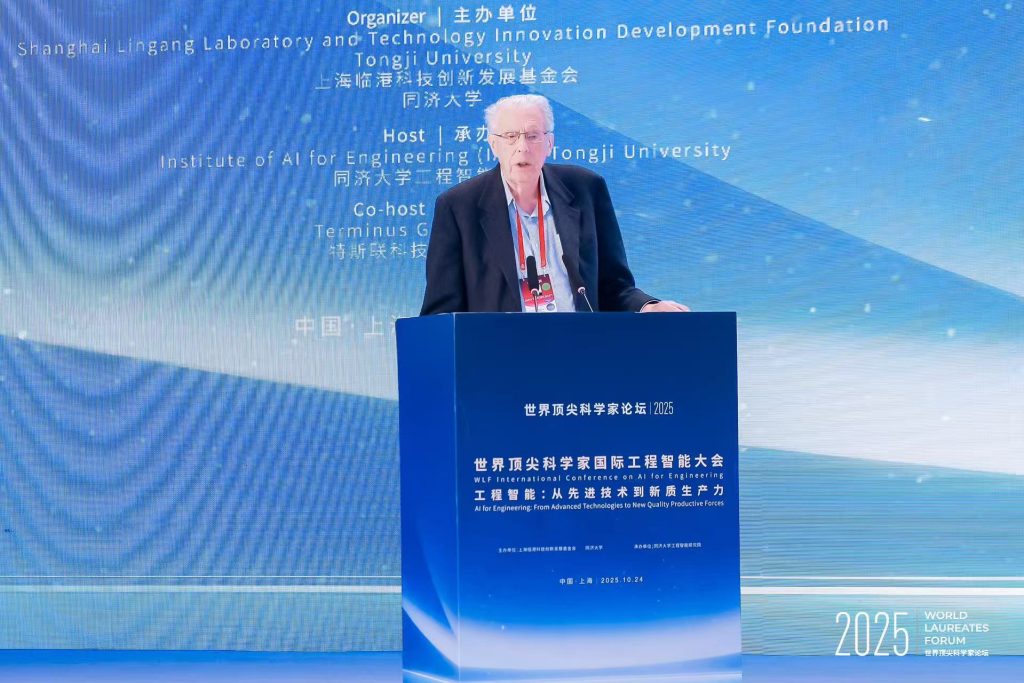
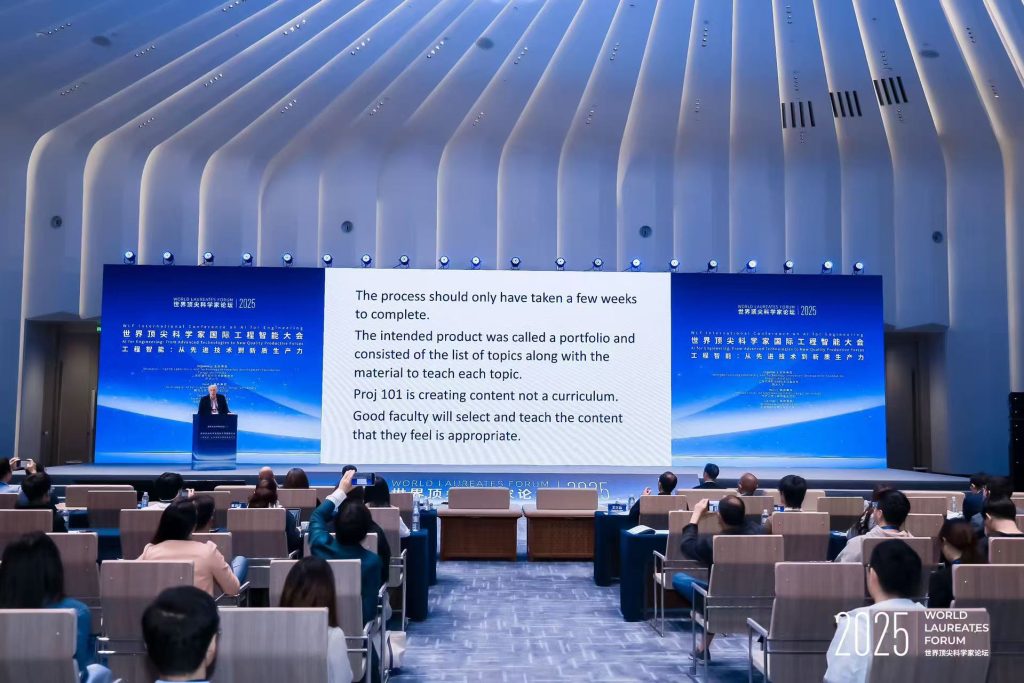
At the Shanghai Lingang Center, under the spotlight, John E. HOPCROFT stepped onto the podium as Chair of the International Engineering Intelligence Conference at the 2025 World Laureates Forum.
As the applause rose from the audience, few might have known that this 86-year-old “master of algorithms” was once, quite literally, pulled onto the lectern by chance.
A Class I Was “Voluntold” to Teach
At Princeton University in 1967, a young John E. HOPCROFT had just completed his Ph.D. in electrical engineering when the department chair approached him with a request, “Could you offer a course in computer science?”
HOPCROFT’s immediate response was, “What should I teach?” The future Turing Award laureate, later recognized as one of the founders of computer science, at that time knew virtually nothing about the field. The chair handed him a few research papers and said, “If you cover these, that will make a good course.”
HOPCROFT did exactly that. The class had only six students, among them future giants of computer science: Jeffrey ULLMAN, Alfred AHO, and Brian KERNIGHAN. Together, teacher and students explored this unfamiliar territory, eventually turning their lecture notes into a book: Introduction to Automata Theory, Languages, and Computation. The text went on to educate generations of computer scientists and remains widely used in universities around the world.
“That was the most enjoyable year of my career,” HOPCROFT later recalled in an ACM oral history interview, “because I was exploring this new field together with my students.”
This “accidental” beginning marked the start of a remarkable academic journey.
Together with Robert TARJAN, HOPCROFT developed a linear-time algorithm for testing graph planarity, introduced the concept of asymptotic complexity into algorithm analysis, and helped define the direction of the field. In 1986, for their fundamental contributions to the design and analysis of algorithms and data structures, he and TARJAN were awarded the Turing Award, the highest honor in computer science.
At the same time, his book The Design and Analysis of Computer Algorithms became a standard reference for generations of computer scientists. He is a member of the U.S. National Academy of Sciences and the National Academy of Engineering, was elected a Foreign Member of the Chinese Academy of Sciences in 2017, received the Chinese Government Friendship Award in 2016, and was honored with the International Science and Technology Cooperation Award of the People’s Republic of China in 2024.
Yet he has never believed that his career was the result of careful planning. As he once told Professor CHEN Baoquan of Peking University, “I’ve asked many Nobel laureates what plans led to their success. They all said, ‘I didn’t have a plan.’ When an exciting opportunity comes along, some people take it. If it’s not exciting, they simply ignore it.”
Perhaps this is the core of HOPCROFT’s philosophy: not planning, but passion and curiosity.
“I Never Went to Work — I Did What I Love”
John E. HOPCROFT was born in 1939 into a working-class family in Seattle. Neither of his parents finished high school, yet they did everything they could to provide him with richer educational opportunities.
Recalling his primary school years, he said: “School started at 9 a.m. and ended at 3 p.m., with an hour in between for homework. After school, I could do whatever I wanted”, he regarded this freedom as an essential part of his education, “because I had to figure out what I wanted to do, and then focus on it.”
That childhood experience of independent exploration shaped the educational philosophy he would carry throughout his life. In May 2025, in an interview with China Education Daily at the World Digital Education Conference, he remarked: “I never ‘went to work’, I went to do what I loved. The people who succeed are the ones who are doing what they truly love.”
In China, however, he saw a very different picture: students attending classes from 8 a.m. to 5:30 p.m., going home to do homework, and then taking additional tutoring classes at night. “Many Chinese children do not have the opportunity to discover what they truly enjoy doing, and that is an important part missing from education.”
This observation became a central driving force behind his efforts to promote educational reform in China over the following decade.
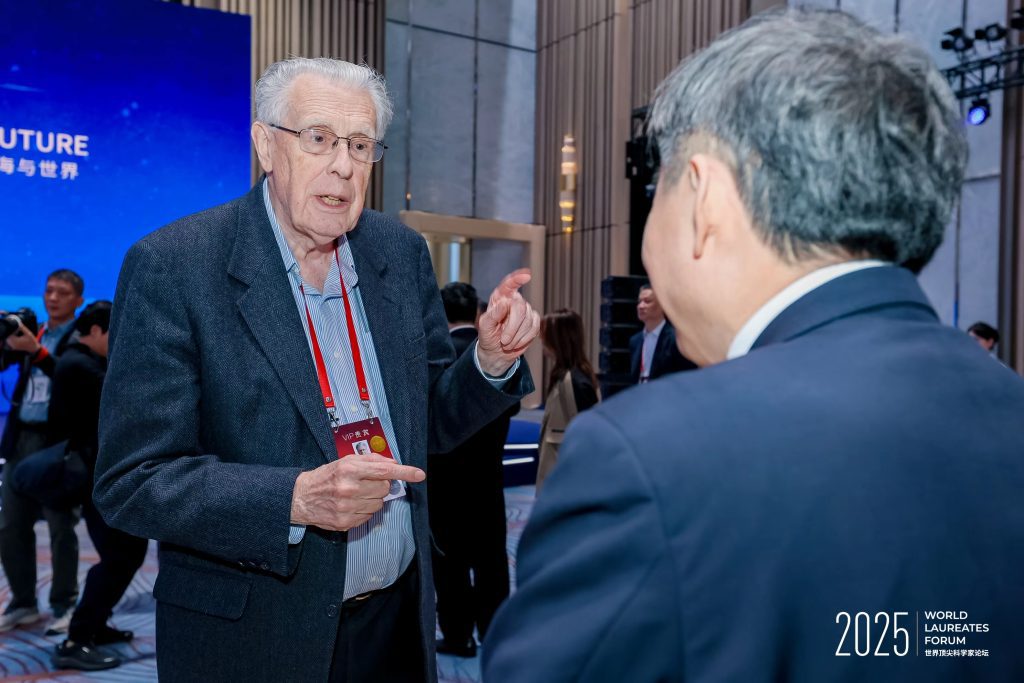
John E. HOPCROFT exchanges ideas with Chinese scientists at the 2025 World Laureates Forum
Fifteen Years Rooted in China
In 2011, at the invitation of Shanghai Jiao Tong University, HOPCROFT came to China for the first time. In every year that followed, he spent three months working at Shanghai Jiao Tong University, personally teaching undergraduate computer science courses. He also arranged for his lecture notes to be published in China free of charge, with only one request: that the price of each book be kept below 30 yuan so that more students could afford them.
In 2017, Shanghai Jiao Tong University established the John Hopcroft Center for Computer Science, named in his honor, with HOPCROFT serving as its founding director. In the same year, Peking University launched the Turing Class, for which he helped design the training program and personally taught courses.
Fifteen years later, his assessment of China has remained consistent, “China is the only country that has made improving education a national priority.” In December 2025, he further remarked in an interview with Xinhua News Agency, “Chinese students are fortunate to have been born in a country that places great importance on artificial intelligence education. China invests heavily in talent cultivation in ways that are rarely seen anywhere else in the world, which shows that it truly regards education as a top priority for national development.”
He has been not only an advocate in principle, but also a driver of concrete action. He was one of the key proponents of the Ministry of Education’s 101 Plan for undergraduate teaching reform, which was first launched in computer science in 2021 and has since expanded to eight foundational disciplines, including mathematics and chemistry, before extending into artificial intelligence in 2024. With HOPCROFT’s support, research centers in computer science were established at Huazhong University of Science and Technology, Shanghai Jiao Tong University, and Peking University, aiming to attract outstanding young talent from China and abroad while enhancing the quality of undergraduate education.
Those who have met him, whether professors or students, simply call this endearing elder scholar “John.”
Educational Inquiries in the Age of AI
In 2025, as the wave of artificial intelligence swept across the globe, many were eager to discuss how AI might transform education. HOPCROFT, however, remained unusually calm.
“Artificial intelligence is certainly influential,” he said in an interview, “but whether it will truly reshape the educational system remains difficult to determine. The only two technologies I am certain have profoundly changed education are the blackboard and the printing press.”
He candidly recalled that when he was younger, he once believed television would completely transform education, but he later realized he had been wrong. “What I failed to appreciate,” he explained, “was the central importance of teacher–student interaction. The strength of a great teacher lies not only in deep knowledge or skillful lecturing, but in being genuinely student-centered and sincerely caring about students’ growth.”
In December 2025, at the International Forum on Basic Education in China, he further stressed, “To replace teachers with artificial intelligence would be equivalent to stripping education of its soul.” Yet he does not reject AI altogether. He believes it can assist teachers in generating exercises, grading assignments, and precisely identifying gaps in students’ understanding. Even so, he remains convinced that the essence of education will always lie in teachers who genuinely care about the growth of their students.
When asked whether artificial intelligence truly possesses intelligence, his answer was direct, “Artificial intelligence is, in essence, a system of pattern recognition and statistical computation. It does not possess such distinctively human capacities as error awareness or genuine cognitive understanding.”
“The mission of education is to help students discover what they truly love and guide them toward careers connected to that passion.” This is a principle HOPCROFT has emphasized repeatedly. At the 2025 World Digital Education Conference, when asked by a reporter to summarize education in a single sentence, he responded without hesitation:
“You only live once, and you should enjoy it. The role of education is to help you discover what you love and guide you toward a life’s work that you truly enjoy.”
In Lingang, Dialoguing with the World’s Top Scientists
The 2025 World Laureates Forum was held at the Shanghai Lingang Center under the theme “Science in Future: Shanghai and the World.” The Forum brought together 25 laureates of the world’s top scientific honors, including the Nobel Prize, the Turing Award, the Wolf Prize, and the Fields Medal.
HOPCROFT was among the Turing Award laureates invited to attend the 2025 World Laureates Forum. Joining him on the Forum stage were other leading scientists, including Jack J. DONGARRA, recipient of the 2021 Turing Award, and Martin E. HELLMAN, recipient of the 2015 Turing Award.
As one of the organizers of the event, the Shanghai Lingang Science and Technology Innovation Development Foundation is deeply honored to contribute to this premier international scientific gathering in Asia and to help build a platform where the world’s leading scientific minds can exchange ideas.
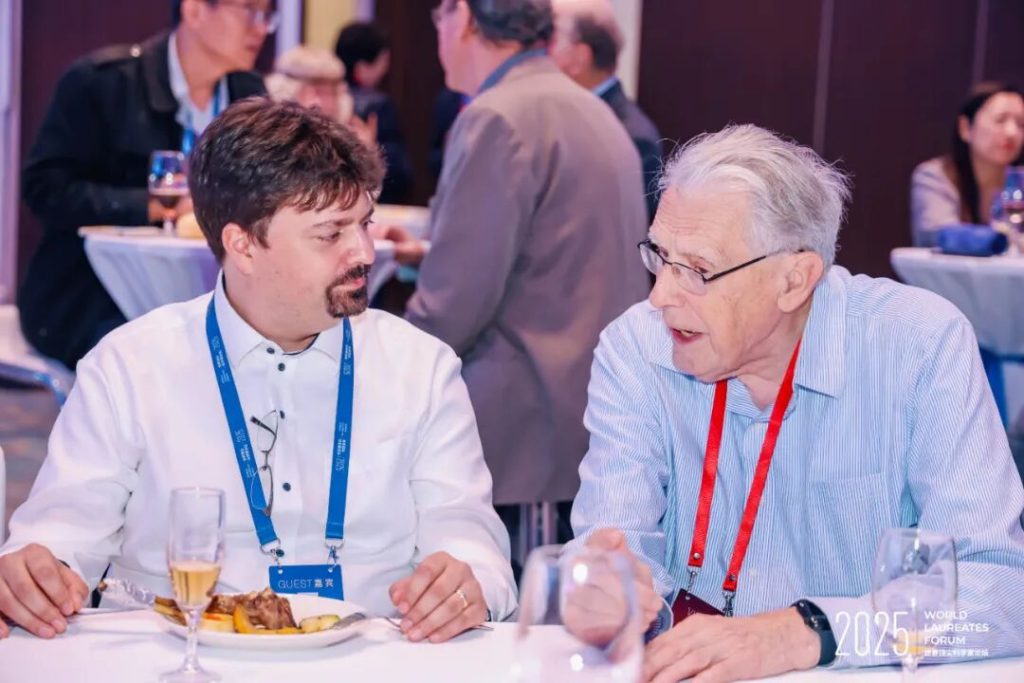
WLF Möbius Night at the 2025 World Laureates Forum
For HOPCROFT, Lingang is no stranger. It is the city he returns to each year to teach, and the base from which he has deepened his collaboration with Shanghai Jiao Tong University. From the classroom podium in Lingang to the spotlight of the World Laureates Forum, HOPCROFT moves effortlessly between the roles of scientist and educator, while the message he shares with the world remains constant:
The essence of education is to help every individual discover the work they truly love. And he himself is perhaps the best embodiment of that belief.
“做你喜欢的事”
In December 2025, at the inaugural Hong Kong International AI Art Festival, HOPCROFT once again offered young people the same advice, “In any field, the most important condition for success is genuine passion.”
That sentence has run through all 86 years of his life.
From a boy in a working-class family in Seattle, to a young Princeton professor who was “pushed” onto the lectern, and then to a “people’s scientist” who has spent fifteen years rooted in China, HOPCROFT has spent his life demonstrating one simple truth, real success is not something that can be planned in advance, it is something one reaches step by step by following what one truly loves.
Although the 2025 World Laureates Forum has drawn to a close, the reflections HOPCROFT leaves for China’s educational community are far from over. As the Shanghai Lingang Science and Technology Innovation Development Foundation, we will continue to support deep collaboration between leading scientists like him and China, so that the light of science may illuminate the path ahead for more young people.

