


“We hope to use every available tool to deepen our understanding of the chemistry and physics of materials, and to help create a sustainable future for humanity.”
He said these words in 2023, when he received the Eni Energy Frontiers Award. Two years later, he received another major honour. The Royal Society awarded him the Royal Medal in the Physical Sciences, one of the highest distinctions in British science.
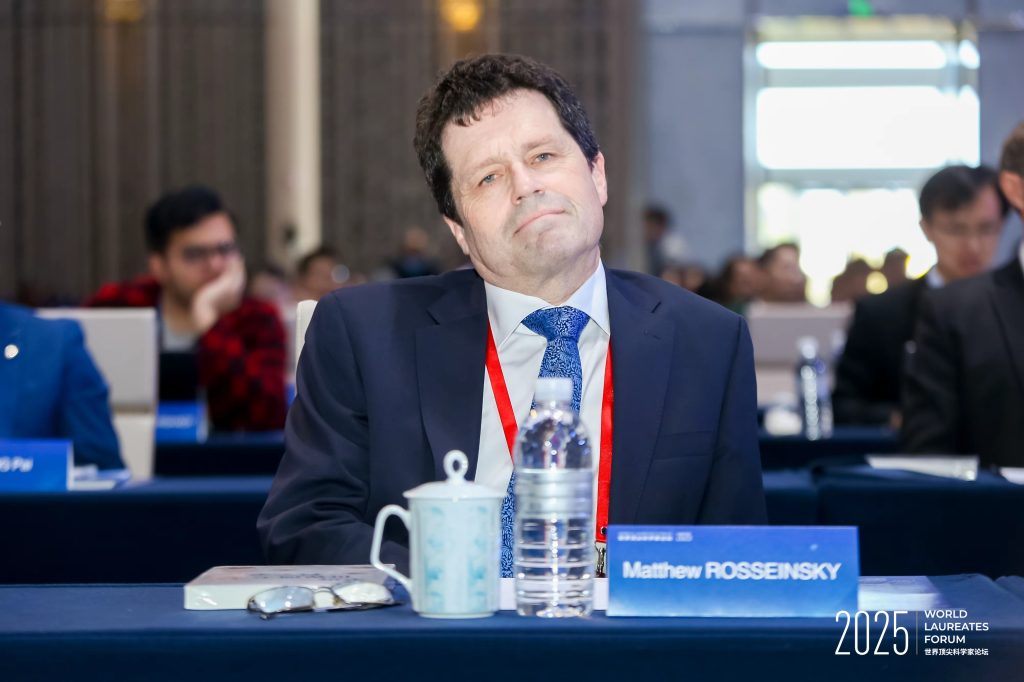
In October 2025, Matthew ROSSEINSKY, a leading materials chemist at the University of Liverpool and Fellow of the Royal Society, came to Shanghai Lingang for the first time as a guest of the 2025 World Laureates Forum. Here, he shared his frontier explorations in using artificial intelligence and digital tools to “design” future materials, and opened a scientific dialogue across East and West.
The Cross-Disciplinary Journey of a Materials Designer
Materials are the foundation of human civilization. From mobile phones and electric vehicles to clean energy and sustainable manufacturing, nearly every technological advance depends on the renewal of material properties. Matthew ROSSEINSKY is a leading scientist who designs new materials at the atomic scale.
ROSSEINSKY graduated from the University of Oxford, where he received both his bachelor’s degree and doctorate in chemistry. After completing his PhD, he carried out postdoctoral research at Bell Laboratories. In 1992, he returned to Oxford as a faculty member. In 1999, he was appointed Professor of Inorganic Chemistry at the University of Liverpool, where he has since devoted more than two decades to materials chemistry.
Along the way, he has received a series of major international honours:
2008
Elected Fellow of the Royal Society
2011
Awarded the Hughes Medal
2017
Awarded the Davy Medal
2023
Received the Eni Energy Frontiers Award, a major international honour in energy research
2024
Appointed Officer of the Order of the British Empire, or OBE, for his contributions to materials chemistry research and innovation
2025
Awarded the Royal Medal in the Physical Sciences, a high recognition of his decades-long scientific career
Yet beyond these distinctions, ROSSEINSKY is most widely recognized for using digital tools to transform the traditional model of materials discovery.
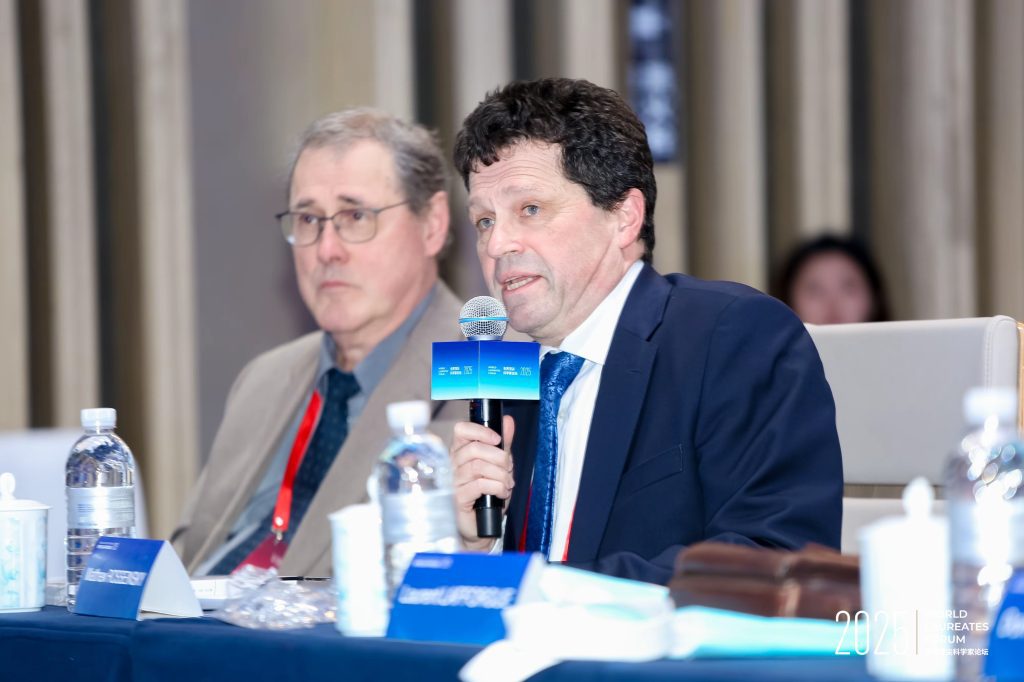
Youth Scientists Conference
No Silver Bullet for Materials Discovery
If one asks Matthew ROSSEINSKY what makes materials science so compelling, he would point to one of the most fundamental challenges in science: controlling the arrangement of atoms and molecules to give materials new functions.
He believes this challenge has no single “magic solution”, because it involves both intrinsic properties at the atomic scale and the ways these properties can be changed through processing. For this reason, he is convinced that the research community must bring together chemistry, physics, and computational methods, gradually building a toolbox of solutions.
This is the direction to which ROSSEINSKY has devoted more than twenty years. His research spans fundamental chemistry and condensed matter physics, focusing on understanding and improving the performance of materials in energy storage and generation, communications, catalysis, and related fields. “The central challenge in discovering new materials,” he has said, “is predicting which combinations of atoms are stable enough to be isolated and made into materials.” He and his team are using digital tools to overcome this challenge, step by step.
From a Typical Day to an Atypical Breakthrough
At the Department of Chemistry of the University of Liverpool, ROSSEINSKY leads a multidisciplinary team that includes postdoctoral researchers, graduate students, and collaborators from industrial partners such as Unilever, Johnson Matthey, Ceres Power, and NSG Pilkington. When asked what a “typical day” in the laboratory looks like, he answered with humour: “I am not sure there is such a thing as a typical day. But deep discussions within the group about new data, continuing exchanges with collaborators, and trying to repair critical equipment that always seems to fail at the least convenient moment, all appear quite often.”
It is from these daily conversations and moments of repair that a series of major advances have emerged. His team has developed new computational techniques and combined them with experimental work to accelerate the identification of new materials with enhanced properties. For example, they successfully designed a material that combines ferromagnetism and electric polarization at room temperature. This was not only a major challenge in fundamental science, but also carries important implications for future technologies in information processing and storage.
In recent years, ROSSEINSKY has gone further, integrating physics-based computational models with machine learning based on experimental data. In doing so, he has helped establish a new paradigm of digitally driven materials discovery. This approach can predict stable chemical compositions through computation, before validating them through synthesis in the laboratory. “We can make excellent materials in the laboratory that go beyond any existing precedent,” he said.
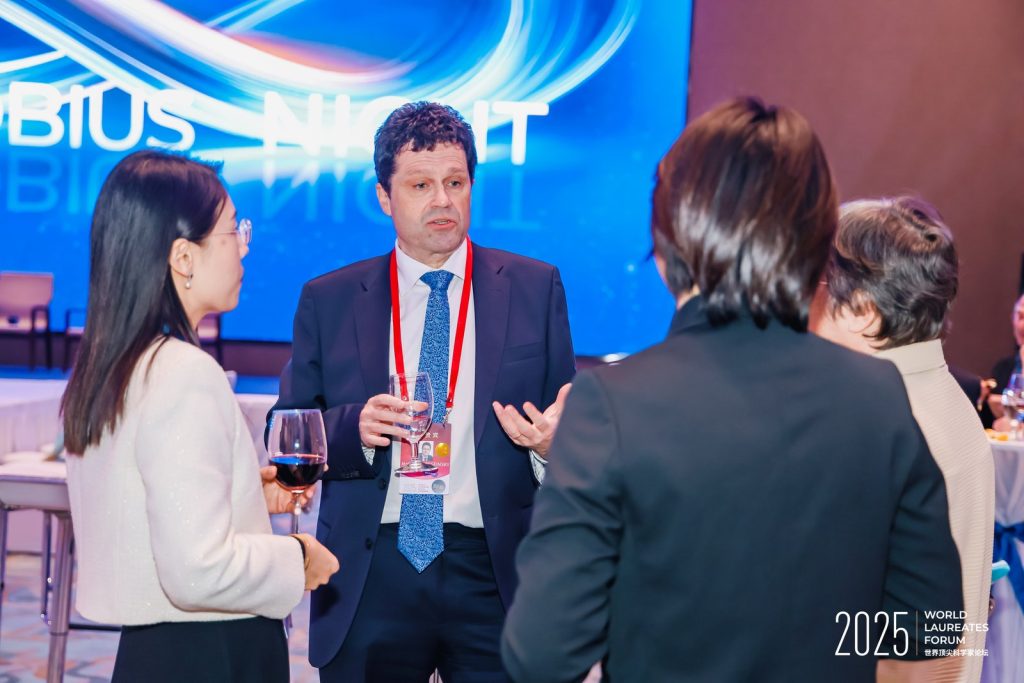
WLF Möbius Night at the 2025 World Laureates Forum
The Royal Society’s Royal Medal
In 2025, ROSSEINSKY’s scientific achievements again received one of the highest forms of recognition in the field. He was awarded the Royal Society’s Royal Medal in the Physical Sciences for his pioneering contributions to materials design and discovery, which have redefined approaches to the synthetic creation of functional materials and transformed research and development through digital tools. The Royal Medal was established in 1825 and first awarded in 1826. Its past recipients include many major figures in science, including Francis CRICK and Frederick SANGER.
Upon receiving the news, ROSSEINSKY said the award reflected the important role played by materials chemistry and the wider condensed matter sciences in everyday life. He expressed particular gratitude to the individuals and institutions that had supported him over the past twenty-five years, especially the multidisciplinary team at the University of Liverpool, major industrial partners, and funding bodies including the Engineering and Physical Sciences Research Council and the Leverhulme Trust. Their support has been vital to the development of the University of Liverpool’s Materials Innovation Factory in artificial intelligence-driven materials design and discovery.
The Digital Future of Energy Materials
ROSSEINSKY’s research has always been closely connected to some of the defining challenges of our time: population growth, climate change, and the development of sustainable energy. He believes that designing and discovering new materials through digital methods is a key path toward addressing global challenges.
His team has made important achievements in energy materials. Using digital technologies, they have experimentally realized new material structures. By combining structure prediction and machine learning, they have developed new materials with strong overall performance. They have also synthesized solid materials containing three different functional anions, enabling precise control of thermal conductivity. These results not only deepen human understanding of the material world, but also open new directions for the development of next-generation batteries, fuel cells, and industrial catalysts.
At the Youth Scientists Conference of the 2025 World Laureates Forum, ROSSEINSKY shared frontier research on how digital tools can empower innovation in energy materials. He emphasized the importance of making full use of diverse technologies, exploring the internal laws of materials chemistry and physics, and working together toward a sustainable future. His sincere sharing was warmly received, and allowed young researchers from around the world to experience the appeal of cross-disciplinary research.
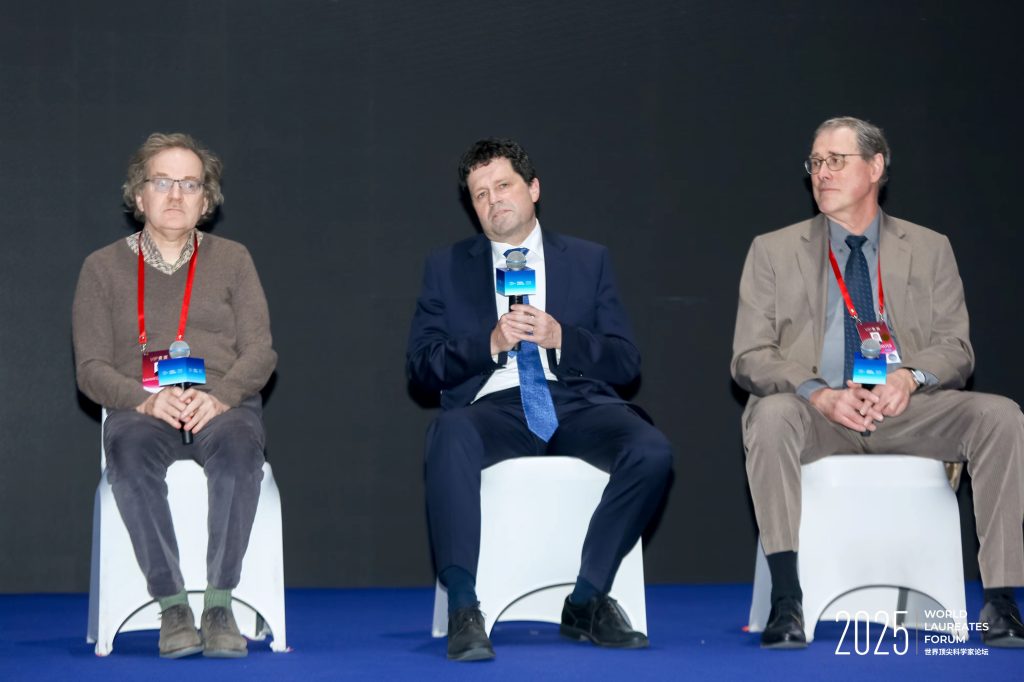
Youth Scientists Conference at the 2025 World Laureates Forum
When younger researchers sought his advice, ROSSEINSKY did not offer abstract instruction. Instead, he drew on his own laboratory experience. He remarked with a smile that repairing faulty equipment often trains the mind more deeply than an experiment that proceeds smoothly from beginning to end. Materials discovery has no shortcut that can be achieved in a single step. The whole field needs to integrate knowledge from multiple areas, accumulate gradually, and build a complete research system.
“Do not be afraid to step outside your comfort zone, and do not fear failure. Talk more, collaborate more, and take each immediate problem seriously. The answer is often hidden within it.”
From Oxford to Bell Laboratories, from Liverpool to Shanghai Lingang, Matthew ROSSEINSKY has continued to cross disciplinary boundaries, reshaping the paradigm of materials research and development through artificial intelligence and digital technologies. Through his work, he has shown that the materials of the future may no longer be merely “discovered” by chance, but precisely “designed”. Shanghai Lingang is witnessing this materials revolution as it gradually changes the world.

