


Shanghai Lingang, at the venue of the 2025 World Laureates Forum.
A Japanese scholar stood on the stage. His tone was calm, yet carried a certainty that was difficult to question. Hundreds of eyes were fixed on him. Some have called him “the Bob Dylan of chemistry”. Some regard him as a strong candidate for future Nobel recognition. Others know only one phrase: the crystalline sponge.
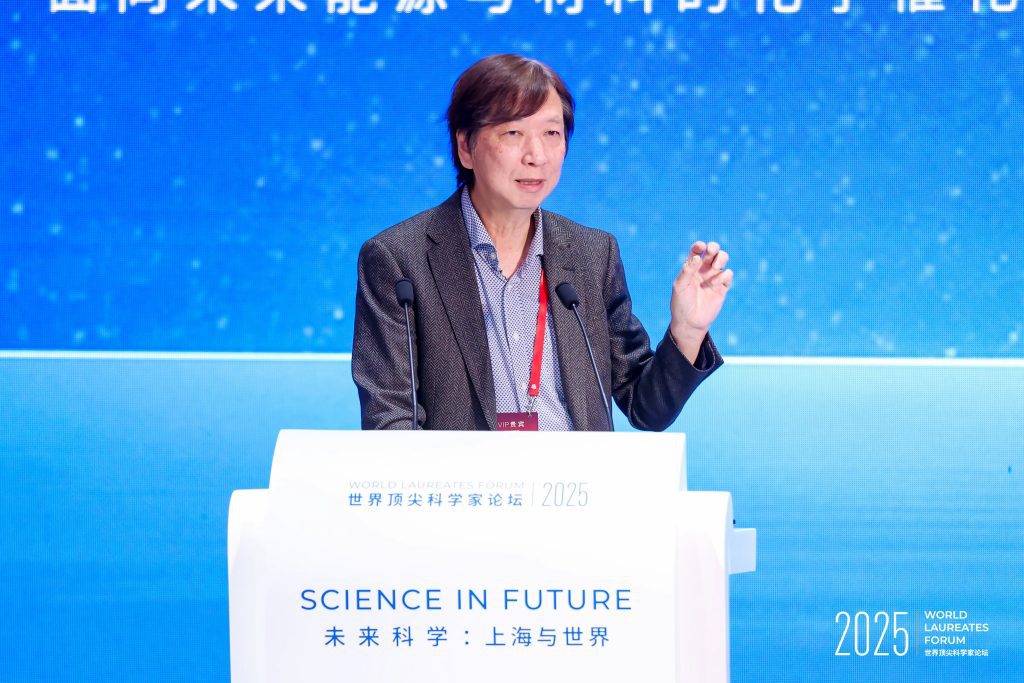
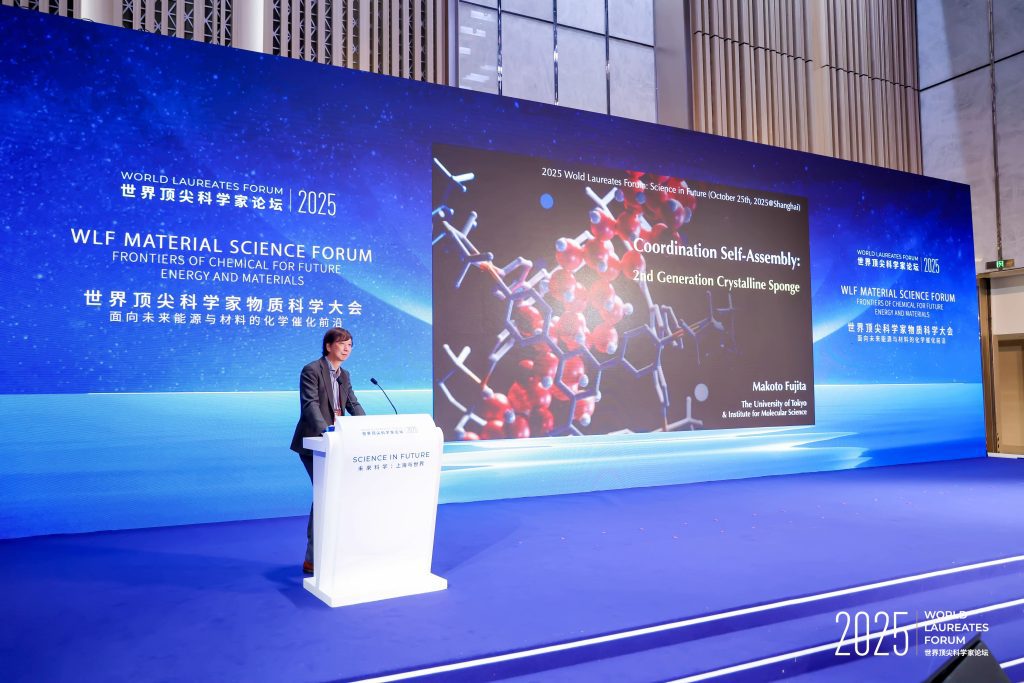
Makoto FUJITA, 2018 Wolf Prize laureate in Chemistry, Distinguished Professor at the University of Tokyo, and Foreign Honorary Member of the American Academy of Arts and Sciences, came to the World Laureates Forum for the first time in 2025.
Thirty years earlier, when he was just beginning this path, his peers had said to him: “This is not chemistry.”
A Long Quest That No One Believed In
In 1982, FUJITA completed his master’s degree at Chiba University and joined Sagami Chemical Research Center. At that time, he turned his attention to a direction that few in chemistry were seriously considering: molecular self-assembly.
Self-assembly refers to the spontaneous formation of ordered structures by molecular units through weak interactions. Biology had already demonstrated this phenomenon in protein folding and the DNA double helix. Yet at the time, few chemists believed that such a mechanism could be used to artificially synthesize new substances.
FUJITA found that the strength of the interaction between metal ions and organic molecules was well suited to controllable self-assembly. But the traditional chemical system did not readily accept this path. In the classical understanding of chemistry, the core of a chemical reaction lies in the breaking and formation of chemical bonds. Self-assembly driven by weak interactions was regarded only as chemistry in a broader sense.
“This is not chemistry.” FUJITA heard this criticism for a full decade.
He did not argue. Instead, he settled into the laboratory and continued his experiments. Starting with simple square-shaped molecules, he gradually built complex three-dimensional cage-like structures, synthesizing a series of molecules that had been difficult to prepare through traditional chemical methods. He once compared the common ground between scientific research and art in this way: “Researchers and creators are alike. Both create something from nothing. Rather than pursuing momentary popular results, we seek works that can influence a field for a long time. Even if few people understand them at first, time will allow them to travel across the world.”
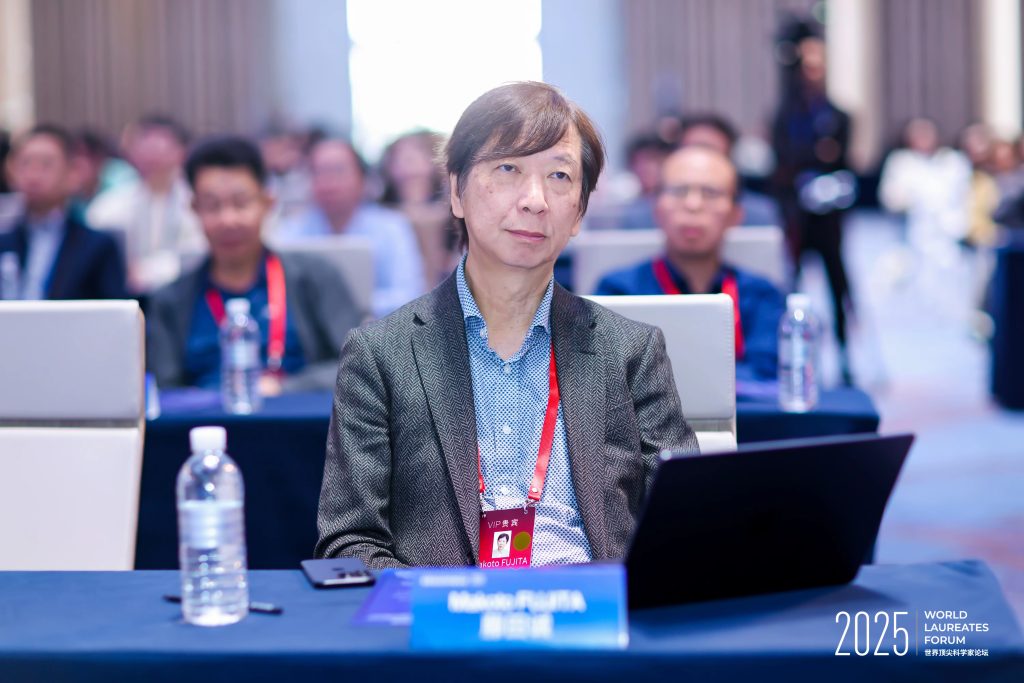
WLF Material Science Forum at the 2025 World Laureates Forum
A Magic Sponge of Chemistry the Size of a Sugar Cube
In 2002, FUJITA began a line of research that appeared highly disruptive at the time. He set out to prepare three-dimensional cage-like porous frameworks assembled from metal ions and organic molecules, with cavities capable of capturing and accommodating guest molecules. Although other groups were exploring similar directions during the same period, none had achieved a decisive breakthrough.
After ten years of continued exploration, FUJITA’s team formally reported the revolutionary crystalline sponge method in 2013. Before this, X-ray molecular structure analysis had faced a century-old bottleneck: the compound to be analysed had to be grown into a complete single crystal before its structure could be determined. Many natural products and drug molecules are extremely difficult to crystallize. Some teams even spent large sums attempting crystallization experiments in space, with limited results.
The crystalline sponge method broke through this limitation. One needs only to take a porous crystalline sponge roughly the size of a sugar cube, immerse it in the solution of the target compound, and allow the solvent to evaporate slowly. The target molecules will automatically arrange themselves in an ordered manner inside the nanoscale pores of the sponge. Without needing to crystallize on their own, they can then be analysed directly by X-ray diffraction to reveal their complete molecular structure.
“The phenomenon had been in front of us for many years,” FUJITA said. “It took me and colleagues around the world ten years to realize its application value.” When the related paper was submitted to Nature, all three reviewers requested no revisions, and the article was accepted as submitted, an extremely rare occurrence in scientific publishing.
Visualizing Chemical Reactions Inside the Sponge
After the crystalline sponge method was established, FUJITA did not stop exploring. He proposed an even bolder idea: placing an entire chemical reaction inside the cavities of the sponge, and using X-rays to observe the reaction process in real time.
“Adsorb chemical substances into the sponge pores, add reagents to trigger a reaction, and then use X-rays to track the dynamic changes in molecular structure.” Before this, scientists could only infer reaction intermediates indirectly from spectroscopic data. FUJITA’s method made it possible to capture the whole reaction process visually, realizing the visualization of chemical reactions.
He has pursued this line of visualization research for nearly ten years. In March 2025, his team developed a second-generation crystalline sponge. The new cage-like porous framework can stably accommodate medium-sized molecular compounds with molecular weights above 1,000, greatly expanding the range of molecular structures that can be analysed. In May of the same year, his team used the self-assembly of peptides and metal ions to artificially construct a dodecahedral spherical molecular shell for the first time in the world.
From Rejection to Redefining a Field
In 2018, FUJITA shared the Wolf Prize in Chemistry with Omar YAGHI of the University of California, Berkeley, in recognition of their pioneering contributions to metal-organic frameworks, or MOFs, and molecular self-assembly.
When speaking about the long-term value of his research, FUJITA once drew an analogy with Bob Dylan. Dylan received the Nobel Prize in Literature not simply because he created many widely sung songs, but because he opened a new expressive paradigm combining poetry and popular melody. In the same way, the true value of FUJITA and his team lies not only in the technical breakthrough of the crystalline sponge, but also in the establishment of a new logic for molecular construction: metal-ion-directed self-assembly. This has reshaped the way supramolecular chemistry is studied around the world.
“In the one or two hundred years of chemical development, there had never been such a system for constructing molecules. We successfully created and expanded a new method of molecular architecture.”
A Voice in Lingang
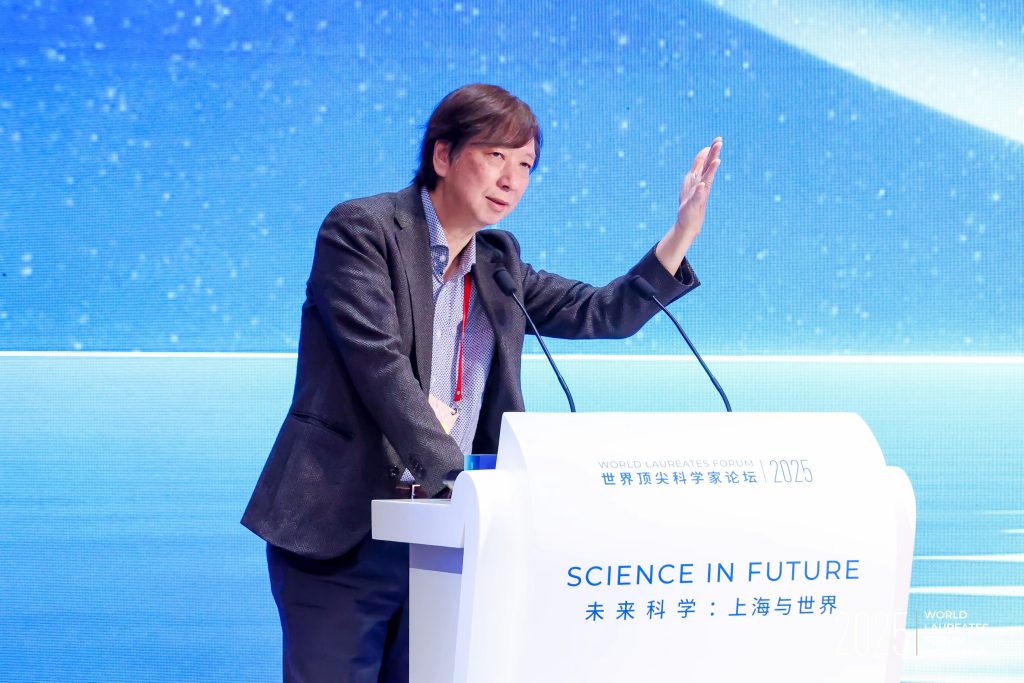
At the 2025 World Laureates Forum in Lingang, FUJITA delivered a keynote speech titled “Coordination Self-Assembly: From Its Origin to the Latest Advances”. He shared his understanding of the essence of scientific research: “The most precious part of research is discovering patterns that others have not noticed, and the pure joy brought by that discovery. If one can achieve something beyond what predecessors have done, that is the best reward.”
Compared with honours and titles, the calmness shaped by decades of concentrated research is what FUJITA values most. He believes that “the essence of science lies in creation and understanding. In science, biology and physics focus more on understanding, while chemistry alone places particular emphasis on creation.”
Once, his research direction was not understood by the mainstream academic community. Today, standing on a global stage of leading science, he has used a crystalline sponge the size of a sugar cube to overturn the traditional methods of chemical analysis.
Toward long-term research, FUJITA has always held a high standard of aspiration: “Set your goal at the summit of a high mountain. Even if you do not reach it, you will still rise far higher than if you had aimed only for a small hill.”

